The Un-Track: Do You Know Who Knows Where You Are?
Your Move Today: Disable continuous location tracking for one non-essential app. Then review your phone and browser privacy settings.
We move through the world as citizens and consumers, but also as data providers.
A quick stop at the store. A doctor’s office visit. A late-night drive. A workplace commute. A repeated trip through the same neighborhood, at the same time to the same house. Many of these movements can be logged, stored, and connected across systems you never directly see. Not because someone is necessarily watching you in the dramatic sense, but because modern digital infrastructure is built to collect, retain, sort, and use information whenever it can.
Most of the time, this does not feel invasive in the moment. It feels helpful. The map opens to your current location. Nearby recommendations appear. Weather updates are localized. Search results feel more relevant. Convenience softens the edges of surveillance.
Now we find that the Government is buying this data to circumvent search-and-seizure protections.
That is part of what makes this challenge worth doing.
The issue is not only that apps collect location data. The issue is continuous surveillance, ongoing data collection, and conglomeration. One signal by itself may not seem significant. But repeated signals gathered over time can reveal routines, patterns, associations, preferences, vulnerabilities, and habits. Data becomes more powerful as it accumulates.
Today’s move is not about disappearing from the world. It is about interrupting one form of passive participation in invisible surveillance systems.
You have reached Day 5 of the Un-Game board, still moving through the Awareness Zone. This part of the journey is about noticing patterns that usually operate quietly in the background. Once we see them more clearly, we can begin deciding how we want to participate.
Many people give location access once and rarely revisit it. An app requests permission during setup. You tap allow. Then life moves on. Weeks or months later, that app may still be collecting information in the background, even when you are not actively using it.
This is one of the defining patterns of digital life now. Permissions are often granted in a moment of convenience, then normalized through repetition and invisibility.
- You may not remember which apps know where you are.
- You may not know how often they check.
- You may not know who else receives or processes that information downstream.
Today’s challenge helps you look.
Today’s Challenge
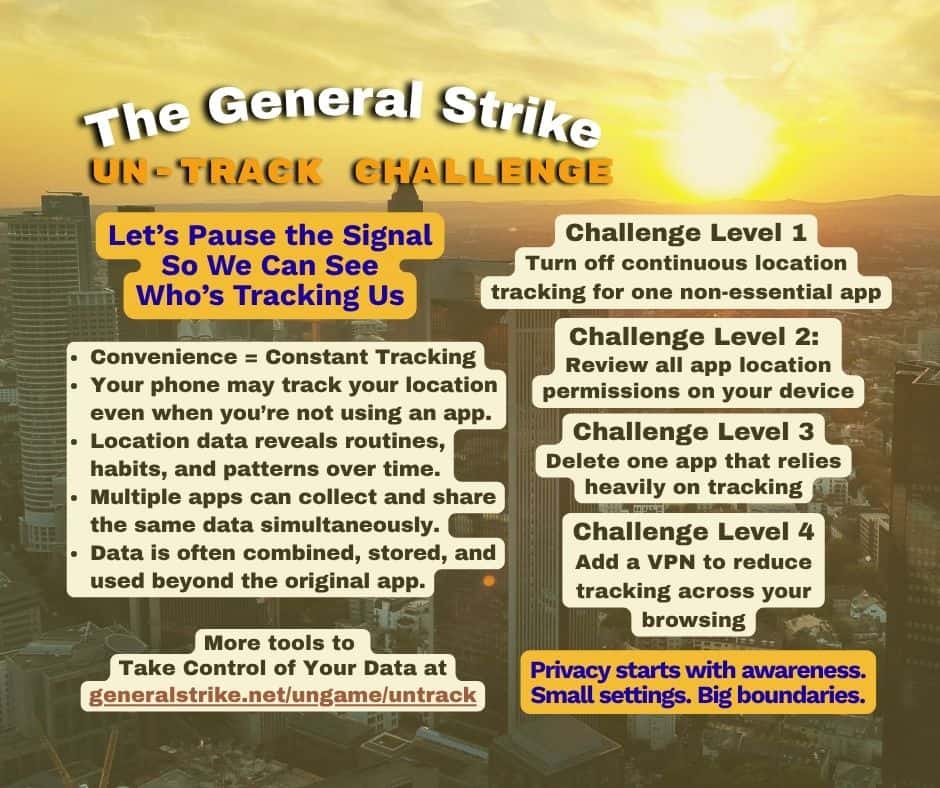
Disable continuous location tracking for one non-essential app.
Choose one app that does not truly need constant access to your location to serve its basic purpose. Change its location permission to “While Using,” “Ask Next Time,” or “Never,” depending on what makes sense for your circumstances
Simple Directions
Start with one app, not all of them.
The goal is not to create digital perfection in one sitting. The goal is to complete one meaningful move and notice what it reveals.
On iPhone:
Go to Settings, then Privacy & Security, then Location Services. Scroll through your apps and see which ones currently have access. Select one non-essential app and adjust the permission.
On Android:
Go to Settings, then Location, then App permissions, or search “permissions” in settings if your device is organized differently. Review the list and change one app that does not need constant tracking.
What counts as non-essential? A non-essential app can function adequately without always knowing your location. This may include shopping apps, restaurant apps, browsers, social media platforms, retail apps, games, travel tools you are not actively using, or other convenience apps. Some apps, like turn-by-turn navigation or emergency tools, may reasonably need location while you are using them. Use your judgment.
Choose a lower-access setting. If available, switch from “Always” to “While Using.” In some cases, “Ask Next Time” may be a good step. In other cases, “Never” is appropriate. The point is not to remove all usefulness. The point is to stop unnecessary background collection.
Review browser privacy settings, too? If you use a mobile browser frequently, review whether it has location access and whether tracking protections are enabled. Many people think of app surveillance, but forget that browsers can also collect and transmit meaningful behavioral information.
Some people feel relief. Some feel uncertainty. Some realize they are not sure which apps deserve access and which do not. That uncertainty is useful. It means awareness is increasing.
For optional steps and deeper guidance, visit the full resource page.
Extended Challenge
Level 2: Review all location permissions
Take 10 to 15 minutes to review every app currently allowed to access your location. You do not have to change them all. Assess them. Which permissions still make sense? Which ones were granted out of habit or speed? Which ones no longer reflect how you want to participate?
Level 3: Delete one high-tracking app
Choose one app you suspect collects more data than the value it gives back. This does not have to be a dramatic decision. It can be a practical one. If an app contributes heavily to passive tracking, distraction, or ongoing surveillance and no longer serves you well, remove it.
Level 4: Add a VPN
A VPN does not solve every privacy issue, but it can reduce some forms of tracking and add a layer of protection when browsing, especially on public networks or across routine web use. Think of this not as disappearing, but as adding friction to systems that assume easy access to your digital behavior.
Each level expands the move from awareness to boundary-setting to redesigned participation.
Why This Matters
Location data is one of the most revealing forms of personal information because movement tells a story.
Over time, repeated location signals can reveal where we live, where we work, which stores we visit, which neighborhoods we frequent, where we worship, where we seek care, who we spend time with, and what routines shape our daily lives. Even when individual data points seem harmless, their accumulation can create a highly detailed behavioral picture.
Modern digital systems often depend on this kind of passive collection because it improves targeting, measurement, personalization, and prediction. The more data a system has, the better it can anticipate behavior. Better prediction increases commercial value.
That matters because systems built around continuous surveillance do not simply observe participation. They learn from it, optimize around it, and strengthen themselves through it.
By reducing unnecessary background location access, you begin to reclaim a personal boundary that may have been quietly surrendered for convenience. This is a small move, but it is also a meaningful one. It reminds us that digital participation is not all-or-nothing. We can keep useful tools while changing the terms of access.
- We do this so that convenience does not completely replace consent.
- We do this so that privacy remains a practical value, not just an abstract one.
- We do this to make participation more conscious.
Structural Impact
Continuous surveillance works because it is passive, normalized, and distributed.
Most people do not wake up and decide, “Today I will contribute to a data aggregation system.” They use their phones. They accept permissions quickly. They rely on convenience features. They move through digital environments that were built to make data sharing easy and review difficult.
This is how the system currently works.
Information is gathered in small, repeated increments.
Those increments are combined with other signals.
The combined data is more valuable than any single piece.
Location data is especially powerful because it connects digital identity to physical life. It helps transform abstract users into trackable patterns. Once those patterns are built, they can support ad targeting, audience segmentation, predictive modeling, consumer profiling, and broader systems of behavioral analysis.
That does not require a dramatic conspiracy to matter.
It only requires scale, repetition, and normalized participation.
Why does this challenge interrupt the pattern?
Because it reintroduces conscious permission into a process that depends on passive consent.
When a person reviews permissions and reduces unnecessary access, the data becomes less complete, less seamless, and less automatic. The profile becomes a little less accurate. The background collection becomes a little less effortless. The assumption of unrestricted access is weakened.
This is not a total withdrawal from technology and it should not be framed that way.
We are dependent on digital systems in part because they were designed to be deeply integrated into daily life. Sudden collapse or total rejection is not the goal. Sudden collapse tends to create instability, confusion, and power vacuums. Strategic withdrawal is different. Strategic withdrawal means adjusting how we participate, where we grant access, and what we normalize.
We are not blowing up the system.
We are redesigning participation within it.
What long-term shift becomes possible when many people make similar moves?
A culture of passive tracking becomes less stable when users become more selective.
Data pipelines built on easy permissions become less reliable when review becomes normal.
Companies must work harder to justify access when people stop granting it by default.
That does not mean surveillance disappears overnight. But it does mean leverage begins to shift.
The long-term correction is not chaos. It is boundary restoration.
It is a future where convenience is weighed against consent.
It is an economy and digital culture in which participation is more intentional and less extractive.
That is a future worth having.
A Note of Reflection
What did you notice when you reviewed your location permissions?
Did any app surprise you?
Did any permission reflect an old habit rather than a current need?
Did you feel how easy it is to grant access once and forget it afterward?
Before beginning the Un-Game, would you have paused to examine this at all?
Awareness does not always begin with a dramatic revelation. Sometimes it begins with one settings screen, one revised permission, one moment of realizing how much runs in the background without our attention.
As you continue through the Awareness Zone, notice how often convenience asks for access first and reflection second.
Closing Acknowledgment
Participation here is voluntary. Progress over perfection.
If you changed one setting today, that matters.
If you only reviewed your permissions and learned something, that matters too.
The Un-Game is not about becoming perfect or paranoid. It is about becoming more intentional in how we engage with the systems that shape our lives.
Most people never look closely at these settings.
You did.
That is one move closer to personal agency.
One move at a time, you’re working your way across the Un-Game board.
Helpful Tools
Proton VPN.
A privacy-focused VPN that can add a layer of protection to your browsing activity and help reduce some forms of network-level tracking.
uBlock Origin (desktop)
A browser extension that blocks many ads, trackers, and unwanted scripts, helping reduce passive data collection while you browse.
DuckDuckGo browser
A browser option designed with stronger built-in privacy protections, including tracker blocking and easier control over some forms of data sharing.
Phone privacy settings
Your phone’s built-in privacy and permission controls are the first and most direct tool for reviewing who has access to your location.
Browser privacy settings
Many browsers allow you to review location permissions, block cross-site tracking, and strengthen default privacy protections with just a few adjustments.
Federal Trade Commission (FTC)
A trusted .gov resource explaining practical steps consumers can take to control personal data and reduce exposure to tracking.