The Un-Distract: What Happens When the Phones Go Away
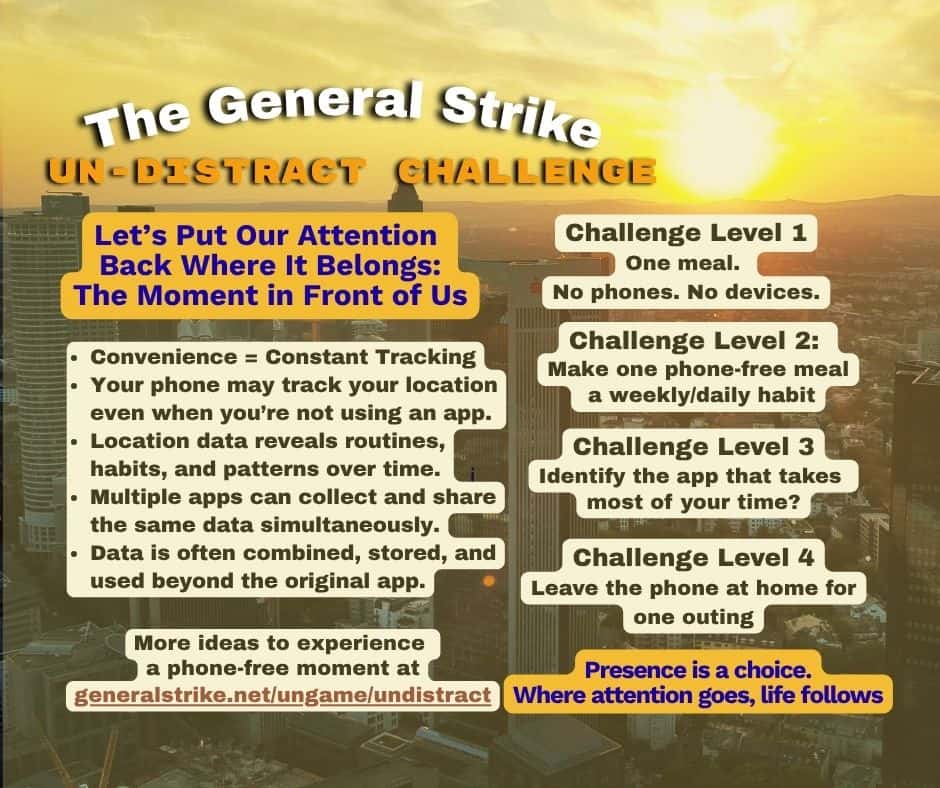
Your Move Today: Spend one full meal or gathering with all phones and devices put away.
You’ve reached Day 6 of the Un-Game board, the final move in the Awareness Zone. Congratulations, we are learning to notice what has quietly become normal.
One thing that has become normal: when we sit down with others, something else often sits with us.
A screen lights up. A watch vibrates and dings. A notification pulls attention away. A quick glance becomes a stolen moment. Conversations pause, fragment, and restart, sometimes mid-sentence. No one intends for this to happen, yet it happens often.
We are present, but partially. Our kids notice. Our friends notice. People in society notice. That partial presence may be contributing to the disconnect many feel in society.
This pattern we have adapted to is not a personal failure. It is something we have learned as a society. It is something we have been taught, knowingly or unknowingly.
Today’s move invites us to notice what changes when that pattern is interrupted.
Interruption has become part of social life. Moments that once held our full attention now compete with devices designed to capture it. Presence is divided.
We may feel like we are fully participating, yet our attention is constantly shifting between the conversation and the device.
We gather together physically while attention is distributed elsewhere.These patterns are subtle. Most of us do not actively choose them. We inherit them.
Does This Happen to You?
You sit down for a meal. The conversation begins.
A pause happens. Someone checks a notification. Another person glances at a message. A moment of silence fills the space where a thought was forming.
No one names it. The pattern continues.
We do not decide to divide our attention. We follow the environment designed for us.
Today’s move creates a small shift in that environment.
Today’s Challenge
Spend one full meal or gathering with all devices put away.
Choose a time when you would normally be with others. Place all devices in another room or out of reach. Phones, watches, tablets, televisions. Everything that competes for attention.
We do this so that we can experience what uninterrupted presence actually feels like again.
Simple Directions
Start with a single gathering.
Choose a meal or moment that already exists in your routine.
Set expectations early.
Let others know you are trying a phone-free experience so the shift feels shared rather than enforced.
Remove devices completely.
Place all devices out of reach or in another room before the gathering begins.
Notice the impulses.
Pay attention to moments when you feel the urge to check a device. You do not need to act on it. Simply notice.
Stay with the experience.
Allow pauses, longer conversations, or even moments of silence. These are part of the reset.
If this feels difficult, adapt the process to your reality. You know your circumstances best.
Extended Challenge
Level 2: Make one phone-free meal a weekly ritual.
Repetition turns awareness into a new default.
Level 3: Ask everyone at the table which app takes up the most of their time.
Notice how awareness expands when it is shared.
Level 4: Leave your phone at home for one outing.
Observe how your attention, movement, and interactions change when the device is not available.See how long you can go without the digital leash.
Each level expands from personal awareness into shared experience and behavioral redesign.
Why This Matters
This is about cutting down on screen time. It is also about understanding how attention systems operate. If they keep us from a connecting across the table, imagine how they undermine our ability to connect with others in our community
Many digital platforms rely on continuous engagement. Notifications, alerts, and updates are designed to bring us back repeatedly throughout the day. These interruptions are not random. They are part of a system that measures and values attention.If you look away. they will try to get you back.
When attention is divided, relationships often take a back seat to engagement cycles.
We don’t need to reject technology, but we do need to understand how it shapes our participation with others around us.
We remove devices from our every moment so that other forms of communication are reopen. When we experience even a short period of uninterrupted conversation, we begin to recognize what has been missing.
We do this so that attention becomes something we direct, not something that is constantly redirected.
Structural Impact
Modern attention systems operate on engagement consistency.
Platforms measure success by time spent, interactions, and return frequency. Notifications and alerts are designed to maintain that engagement throughout the day, including during moments that were once reserved for uninterrupted human interaction. We have challenges in the future that will revisit this.
We are dependent, in part, because these systems were designed to be integrated into daily life. Their convenience and constant presence make participation feel natural.
This challenge introduces a temporary interruption in that system.
We are not removing technology from our lives. We are redesigning how and when we engage with it. A sudden and complete withdrawal from digital systems would create disconnection, inefficiency, and new challenges. These systems currently serve real functions.
Strategic interruption, however, creates awareness.
When we begin choosing when to engage, rather than responding automatically, we introduce variability into a system that depends on predictable attention patterns.
Over time, our participation changes.
- We are not stepping away from the system entirely.
- We are reshaping our role within it.
This is how attention becomes something we direct, rather than something that directs us.
A Note of Reflection
- What did you notice when attention was no longer divided?
- Did the conversation deepen, slow down, or feel different in some way?
- Before this move, how often did we accept partial attention as normal?
What does full presence feel like now? - Do you think that if we collectively changed the way we participate in the systems, the systems would be forced to participate differently with us?
As we complete the Awareness Zone, we begin to see more clearly how participation patterns shape everyday life. In the next phase, we will begin experimenting with more direct ways to interrupt those patterns.
Closing Acknowledgment
Even noticing the urge to reach for a device is a meaningful step. Awareness changes how we participate. Pausing that urge is the next step.
Most people move through these moments without questioning them. We paused long enough to see it. and when we notice it, we have a choice and that is personal power
That is how patterns begin to change. The next zone will start to see how paying attention is costing us!
Helpful Tools
iPhone (iOS)
Screen Time
Go to Settings → Screen Time.
Tap “See All Activity” to view daily and weekly usage.
Review which apps take up most of your attention
Do Not Disturb / Focus Mode
Go to Settings → Focus.
Select “Do Not Disturb” or create a custom Focus.
Set a schedule or turn it on manually
Notifications
Go to Settings → Notifications.
Select individual apps to turn notifications on or off.
Adjust alerts, sounds, and banners to reduce interruptions.
Android
Digital Wellbeing (Screen Time)
Go to Settings → Digital Wellbeing & Parental Controls.
View your dashboard to see app usage and screen time.
Tap apps to set limits if desired
Do Not Disturb
Go to Settings → Notifications → Do Not Disturb.
Turn on manually or set a schedule.
Customize which calls or alerts are allowed
Notifications
Go to Settings → Notifications → App notifications.
Select apps to turn notifications on or off.
Adjust notification categories for more control.
This keeps it practical, fast to follow, and aligned with the “low friction” principle.
Helpful Links
Center for Humane Technology
How technology is shaping attention and behavior
https://www.humanetech.com
American Academy of Pediatrics – Media Use Guidelines
Healthy media use and screen time recommendations
https://www.aap.org
Harvard Health Publishing – Digital Distraction
How digital distractions affect focus and relationships
https://www.health.harvard.edu
National Institutes of Health (NIH)
Provides peer-reviewed research on attention, cognition, and digital behavior, increasing trust and authority for the topic research on screen time and attention patterns
https://www.ncbi.nlm.nih.gov