How the Politics of Fear Survived McCarthy, Mutated Within the GOP, and Reemerged in the Age of Trump
I found myself thinking about McCarthyism the other day, not as a history lesson, but as a familiar feeling like we’ve seen this before.
What I found raised many more questions and, once answered, gave me a better understanding of how we arrived at this point in American politics. You may be interested.
What McCarthyism Really Was
We’re told McCarthyism was an era. A cautionary tale we outgrew. A moment when one reckless man went too far and paid the price. That story is comforting. And incomplete.
Joseph McCarthy didn’t invent the politics of fear; he demonstrated it. Others refined it. Many benefited from it. And long after his fall, the tactic continued to move, quietly, through American politics.
At its core, McCarthyism worked because it didn’t require truth. It relied on fear to do the work.:
- Accusation replaced evidence
- Guilt by association
- Loyalty tests replaced debate
- Public intimidation and reputational destruction
- Delegitimization of institutions that resisted
The accusation itself was the punishment. Defending yourself made you look guilty. Asking for proof made you look disloyal. Weaponized fear did the rest.
McCarthy wasn’t alone. He never was. Ambitious figures in the early Cold War years learned quickly that suspicion was faster than persuasion.
- Richard Nixon built his career by prosecuting alleged communists with relentless focus.
- Ronald Reagan, as a Hollywood labor leader, cooperated in investigations that ended careers.
- Strom Thurmond wrapped civil rights opposition in anti-communist language.
- McCarthy’s chief counsel, Roy Cohn, perfected legal intimidation as a political weapon.
- J. Edgar Hoover’s FBI provided surveillance, maintained files, and offered quiet institutional persuasion.
This wasn’t fringe behavior. It was a proving ground for the politics of fear.

How McCarthyism Was Defeated but Not Destroyed
McCarthyism didn’t collapse because Americans stopped being afraid. It collapsed because the tactic was exposed, on live television, long enough for people to recognize the pattern.
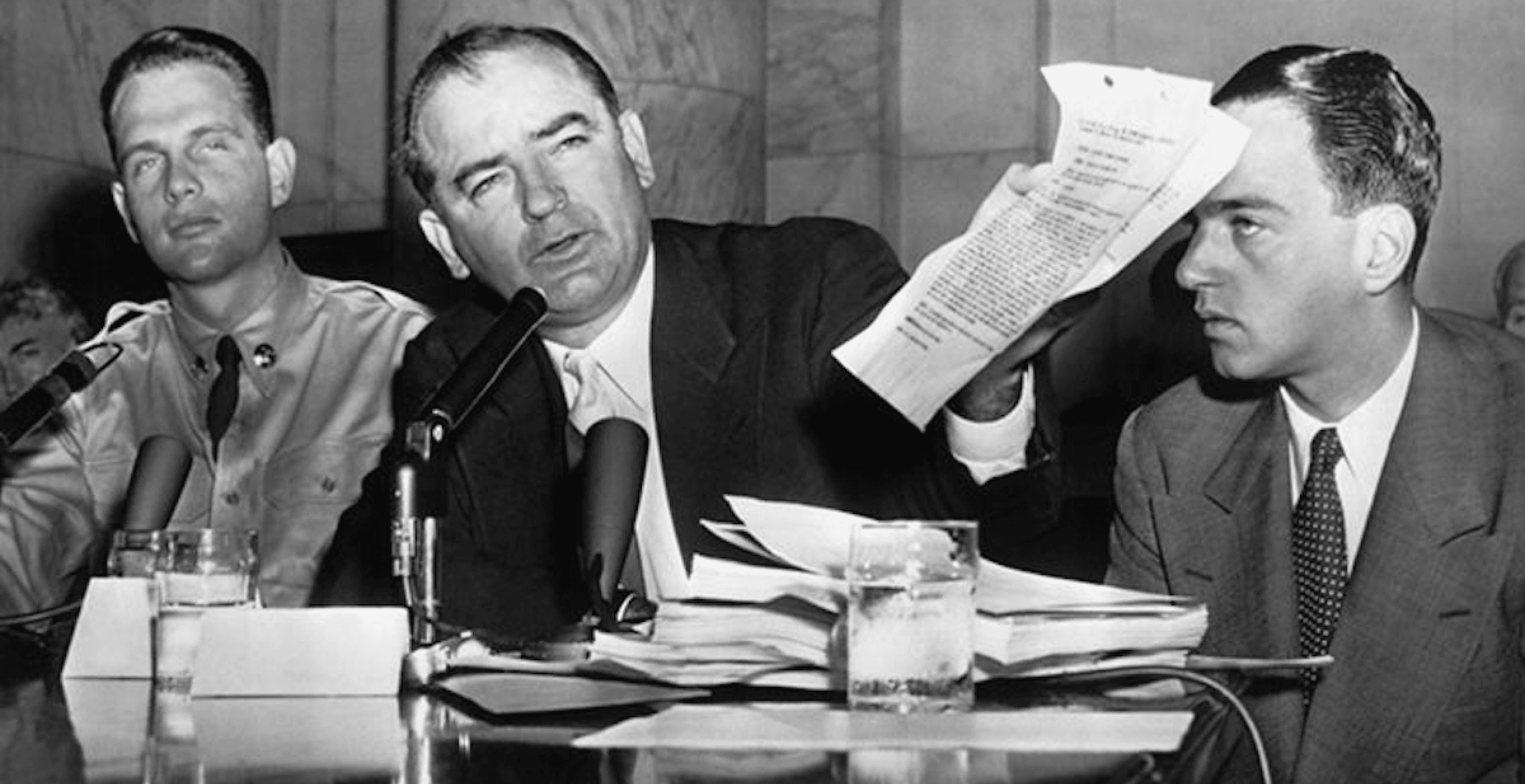
During the Army–McCarthy hearings, the country watched the bullying, the insinuations, the absence of evidence, and the casual destruction of reputations. Something shifted.
American Citizens Were Crucial in Breaking the Spell.
At one point during McCarthy’s smear campaign at the hearings, Joseph Welch, an attorney representing the U.S. Army, responded with a question that echoed across the country: “Have you no sense of decency, sir?”
That moment mattered because it named what people were already feeling. It reframed the conflict not as left versus right but as decency versus abuse.
Edward R. Murrow did something equally powerful. He didn’t argue with McCarthy. He let him speak uninterrupted and trusted the public to recognize the pattern. McCarthyism thrived on distortion. Transparency was lethal to it.
Equally important was the role of ordinary citizens. Teachers, union members, civil servants, artists, and veterans had endured years of intimidation.
McCarthy was discredited, isolated, and contained. The Senate censured him not because it rejected the tactic, but because McCarthy had become politically inconvenient.
McCarthyism Wasn’t Over. It was Contained.
Nixon: McCarthy-Era Tactics as Institutional Power
Richard Nixon’s rise started in the McCarthy era. In the late 1940s and early 1950s, Nixon made his name by pursuing alleged communists with relentless focus. He understood early that accusations created headlines, and headlines created power.
Where McCarthy bludgeoned, Nixon maneuvered. He wrapped suspicion in legal language.
As president, Nixon institutionalized McCarthyistic instincts: enemy lists, intelligence agency abuses, and the framing of dissent as subversion. The target was no longer communism alone but any challenge to authority.
Nixon proved that McCarthyism did not need spectacle to survive. It could be Institutional. Procedural. Quiet, at least for a while.
Reagan: Normalizing the Tactic Into Respectability
Ronald Reagan’s participation in McCarthy-era politics was less overt yet no less consequential. As a labor leader in Hollywood, Reagan cooperated with investigations that ruined careers. He learned that ideological conformity could be enforced without ever appearing cruel.
By the time Reagan reached national office, overt McCarthyism was taboo, but its moral framing remained intact. Reagan cast liberalism not as an alternative philosophy but as a threat to American identity. The language softened, but the structure remained.
McCarthyism under Reagan became normalized, at least for a few.
Bush: Mobilizing the Tactics to Public Life
George W. Bush showed how fear politics could operate entirely through policy. After 9/11, loyalty wasn’t demanded publicly; it was assumed.
Phrases like “you’re either with us or with the terrorists” echoed McCarthy-era binaries, recasting dissent as risky while avoiding overt accusation. Surveillance agencies replaced blacklists. No-fly lists and enhanced screening replaced congressional hearings. Suspicion became infrastructure.
Translating suspicion into government procedure showed that the evolution of McCarthyism required only a crisis, compliant institutions, and a public conditioned to accept fear as leadership.
Roy Cohn: The Bridge Between Eras
Nixon institutionalized McCarthyism, Reagan normalized it, George W. Bush mobilized it, but Roy Cohn preserved its soul so it could be rebranded for the digital age.
As McCarthy’s chief counsel, Cohn learned that power isn’t about being right, it’s about dominating the narrative. His rules were simple:
- Never apologize
- Never admit error
- Attack the accuser
- Turn law into a weapon
- Measure success by intimidation, not truth
Trumpism: McCarthyism Without Restraint
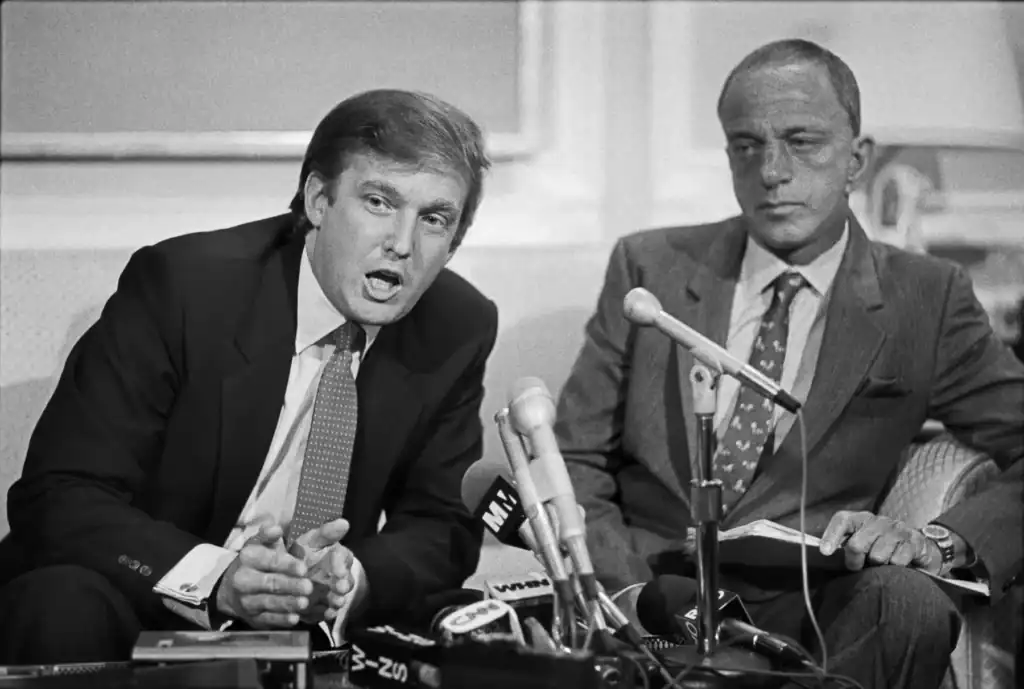
Donald Trump did not invent Trumpism. He was trained in it.
Cohn mentored Trump in the 1970s, teaching him to treat lawsuits as publicity, regulations as persecution, and critics as enemies. Trump absorbed the lesson completely.
When Donald Trump entered politics, many observers treated his behavior as unprecedented. In fact, it was familiar.
- Accusations without evidence.
- Loyalty tests.
- Attacks on judges, journalists, and civil servants.
- Claims that elections were illegitimate unless he won.
This wasn’t new. What was new was the lack of institutional resistance.
Trumpism doesn’t arise in a vacuum.
Fear-based politics flourishes under specific economic and structural conditions that make fear profitable, dissent costly, and simplification attractive.
Economic Precarity Paired With Extreme Inequality
When wages stagnate, debt rises, and stability disappears, fear becomes a dominant emotional currency. When extreme inequality obscures the real sources of pain, anger gets redirected sideways, toward immigrants, educators, public servants, and activists.
The easy thing about fear is it offers emotional clarity without intellectual understanding. Instead of directing anger upward, toward monopolies, financialization, or regulatory capture, it protects the powerful by giving people someone else to blame.
Financialization of Politics and Permanent Campaign Economics
Modern politics is a perpetual revenue cycle rewarded by outrage. Fear converts more reliably than policy.
- Suspicion keeps audiences engaged.
- Loyalty tests discourage nuance.
- Escalation becomes profitable
Political survival depends on attention and rewards escalation rather than resolution. As a result, fear becomes economically viable.
Decline of Labor Power and Collective Economic Institutions
Strong unions and labor movements historically acted as counterweights to “the politics of fear” by anchoring people in shared material and economic interests. As unions were destroyed, isolation filled the gap, and fear rushed in.
This isolation amplifies the politics of fear, leaving people vulnerable to narratives that personalize blame for systemic economic struggles. The erosion of labor unions also removes one of the few institutions capable of resisting economically based intimidation.
Media Conglomeration as the Bridge from McCarthyism to Trumpism
McCarthyism relied on amplifying unfounded accusations, and over the decades, the U.S. media environment has evolved into an ideal incubator for its return. As media ownership consolidated into the hands of billionaires and multinational corporations, journalism shifted from a civic function to an attention-driven commodity.
This transformation did not simply weaken resistance to fear-based politics—it trained audiences to accept it. Journalism became an attention economy. Outrage outperformed verification. Repetition manufactured legitimacy.
Where McCarthy relied on hearings and headlines, modern media systems offered something far more powerful: a permanent, self-reinforcing echo chamber.
By the time Donald Trump entered politics, the infrastructure that McCarthy lacked had already been fully formed. Cable news, talk radio, social platforms, and algorithmic newsfeeds rewarded accusation over evidence and spectacle over accountability. Structural incentives alone ensured that:
- Inflammatory claims would dominate,
- Dissent would be flattened into disloyalty, and
- Repetition would manufacture legitimacy.
The press, reshaped by decades of consolidation and economic pressure, was no longer positioned to confront accusations decisively; it was organized to circulate them.
The Blue Scare
This is the point where McCarthyism stops being a historical episode and becomes a governing style once again. Trumpism did not resurrect the Red Scare; it updated it.
The color changed. The mechanism did not. What emerged was the Blue Scare: a politics of suspicion perfectly adapted to a media economy that monetizes fear, fragments truth, and conditions the public to experience democracy as a perpetual crisis.
The Red Scare targeted communists. The Blue Scare targets radicals, globalists, the deep state, journalists, educators, civil servants, and voters themselves.
The labels are intentionally vague. Their purpose is to seek permission to dismiss opposition as illegitimate, to replace debate with suspicion, and to frame democracy itself as a threat.
This is not about ideology. This is about maintaining power through fear.
Why This Matters Now and What We Do Together
As another election season approaches, history tells us what to expect. Fear doesn’t retreat quietly. It escalates. Accusations multiply. Institutions are strained. Information gets louder and more destabilizing.
This is not a moment for complacency, nor is it a moment for despair.
The pendulum will swing away from Trumpism.
Fear does not defeat itself. It exhausts people. It isolates them. It wears them down until disengagement feels like relief. That is how the tactic wins even after it loses power. Our task isn’t just to outvote fear. It’s to outlast it.
That means preparation, not for catastrophe, but for pressure. Pressure on our attention, on our relationships, on our sense of reality.
It means strengthening our households so disruption doesn’t become a crisis. Reducing dependence on systems that profit from chaos. Checking on one another. Building local networks before we’re forced to.
It means cultivating mental and emotional resilience so we can remain grounded, humane, and connected when the noises of fear crescendo.
We are not merely trying to survive, and we are not pretending that this moment will be easy. But we must hold steady together. maintaining dignity, agency, and care under strain so that we can emerge with our communities and our country intact.
This is where collective action begins: Protests and boycotts are tools of a general strike. Coordinated non-participation is power. Mutual aid is resilience. Solidarity is the antidote to suspicion.
GeneralStrike.net exists for this reason. Not to tell people what to think, but to help us practice a different way of being together while the old tactics burn themselves out. We don’t need to overpower fear. We need to remain human long enough to build something better in its place.
We do this together.
We start now.
Dancing Quail