The Un-Subscribe: Take Back Control
Turn Recurring Charges into Reclaimed Power
Recurring charges are designed to be easy to start and easy to forget. That’s the point. When money leaves your account automatically, you don’t just lose dollars. You lose clarity. And when clarity goes, intention usually goes with it.
Automatic charges add up without awareness. A $9.99 here, a $14.99 there. These charges don’t feel “big,” so they don’t trigger attention. But over time, they create financial fog. Fog makes it harder to plan, harder to choose, and easier to stay stuck.
Convenience replaces intention. Subscription systems reduce friction on purpose. The less you notice, the longer you stay enrolled. That’s not a moral judgment; it’s a business model.
Small drains erode your sense of control. When your money is already spoken for before you decide what you need, your options shrink. And when options shrink, it’s easier to default to “whatever happens happens.”
This challenge is about one clean interruption: Reexamining our current subscriptions and making decisions that prepare us for possible economic disruptions that would come from a General Stike.
Today’s Challenge
Cancel at least one non-essential paid subscription.
That’s it. One.
We’re not trying to become the perfect minimalist. We’re simply proving to ourselves that our money moves only when we choose.
Simple Directions Explained
Start with the easiest win. The goal is completion, not complexity.
Step 1: Find what’s recurring.
Open your bank account, credit card account, or payment app and look for a section labeled “recurring payments,” “subscriptions,” or “merchant agreements.” If you can’t find a dedicated section, scan the last 60–90 days of transactions for recurring charges.
Step 2: Identify one non-essential subscription.
Non-essential doesn’t mean “bad.” It means: if it disappeared tomorrow, you’d be okay.
- A service you rarely use.
- A trial you forgot about.
- A convenience you can replace with something simpler.
If you’re unsure, ask one question: Would I knowingly buy this again today at full price? If the answer is “no,” it’s a strong candidate.
Step 3: Cancel directly through the source.
Cancel through the place that actually bills you:
- Apple subscriptions manager
- Google subscriptions manager
- The service’s website/account settings
- Your bank or credit card recurring payments tool (sometimes you can stop it there)
If you run into resistance (loops, “pause instead,” special offers), remember the purpose: you’re practicing intentional participation.
Step 4: Confirm cancellation and take one screenshot or note.
Not as proof for anyone else, just as a personal marker. Write down:
- What you canceled
- The monthly amount
- The date
That single note becomes a tiny receipt of reclaiming: I changed the pattern.
Optional: Make it harder to re-enroll impulsively.
Remove the card from the account, delete saved payment methods, or set a calendar reminder to re-evaluate in 30 days if you paused rather than canceled.
Extended Challenge
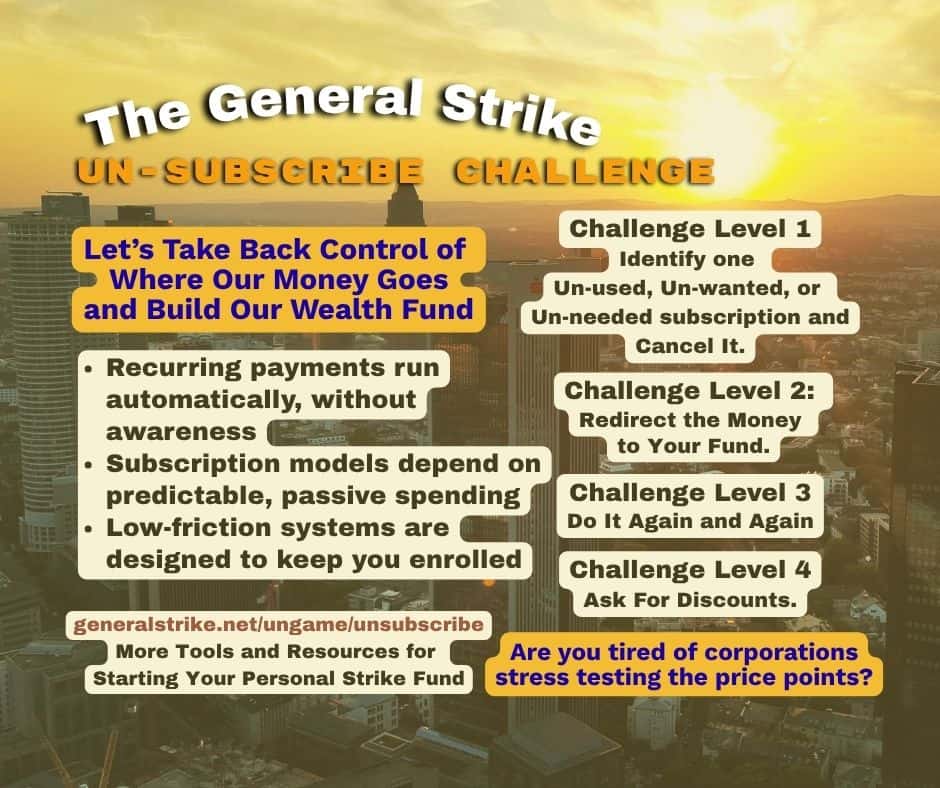
Level 2: Redirect the reclaimed money.
Take the monthly amount you just freed and immediately send it to something that strengthens you:
- Pay down a credit card balance
- Build a small buffer (even $10–$25 counts)
- Fund a practical resilience purchase (staples, tools, training)
Level 3: Get strategic about your redesign.
Repeat this for as many as times as you can.
Review your prescriptions and ask yourself. Do I really need this?
Level 4:
Begin the cancellation process on all subscription services. See if the retention policy offers you a discount for a period of time.
Before completing the cancellation, take a moment to review any offer presented and decide if the service is worth continuing at the reduced price.
If it aligns with your priorities, you can accept the discount. If not, continue with the cancellation. The goal is not just to cancel, but to make a conscious decision about whether the service deserves your participation.
Why This Matters
Subscription billing is one of the most powerful forms of “set-it-and-forget-it” revenue extraction because it stabilizes corporate revenue. When companies can predict recurring payments, they can forecast growth, borrow with confidence, and scale business models around your inertia.
From a systems perspective, recurring charges do three things:
- They normalize automatic participation. You’re enrolled by default, not by choice.
- They reduce friction that would otherwise prompt reconsideration. Cancellation steps are often intentionally buried or delayed.
- They turn attention into profit. The less you notice, the more reliable the revenue is.
When you cancel intentionally, even once, you disrupt that predictability. You reclaim a small piece of leverage: the ability to say “not this” and mean it.
We do this so that participation becomes conscious again, one choice at a time. The reason it is first is that it can save you hundreds of dollars this year if you are diligent.
Structural Impact
We are dependent, in part, because systems were designed to reward that dependency. Subscription models aren’t inherently evil. They’re simply optimized for one outcome: reliable extraction through low-friction defaults.
A sudden collapse of systems doesn’t automatically create freedom; it can create instability and power vacuums. That’s why this program isn’t about chaos. It’s about redesign.
This is a strategic withdrawal. Once we recognize that a subscription model no longer serves us and decide to withdraw from it, we can apply the same approach to other models as well. When we do this collectively, we can create change. By reducing our reliance on automatic extraction, we regain:
- Leverage (companies must earn ongoing participation)
- Stability (more margin, less financial fog)
- Choice (money isn’t pre-spent before you decide)
We are not blowing up the system. We are reshaping how we participate in it so that the future trends toward an economy that works for everyone.
A Note of Reflection
Notice what it feels like to interrupt something “small” that was running without your awareness. Where else in your life has convenience quietly replaced intention?
And if your money is a vote for what you keep alive in the world, what do you want it to fund on purpose?
Closing Acknowledgment
This is voluntary.
Remember Progress over perfection. Even a little today is better than a bunch tomorrow. You can do more tomorrow.
If you canceled one thing today, you did the work. You proved that participation doesn’t have to be automatic. You can choose. You can redirect. You can rebuild your role as an intentional participant, one clean decision at a time.
Helpful Tools Explained
Rocket Money (subscription tracking):
Helps identify recurring subscriptions you may not remember signing up for and makes it easier to review them in one place.
Your bank/credit card “recurring payments” view:
Many banks now show merchants with recurring authorizations. This is often the fastest way to see what’s draining your account automatically.
Apple subscriptions manager / Google subscriptions manager:
If you subscribed through an app, these dashboards are usually the only reliable place to manage and cancel subscriptions.
Your transaction history (60–90 days):
The simplest tool of all. Repetition reveals what’s been normalized.