When people think of picket lines, they usually picture workers standing outside their workplaces, perhaps around a metal barrel with a fire inside, signs raised, and chants echoing. We know they are demanding better wages, safer working conditions, or respect for their labor union. This image is deeply tied to the history of labor movements and workers’ rights. Picket lines are not only a labor union tool but also an effective strategy in a general strike.
A consumer picket line is a peaceful protest by customers, not workers, on public sidewalks to pressure corporate policy. This article explains when it’s legal, how it’s been used historically, and how local groups can apply it today.
Over the past week, renewed national attention on Starbucks workers organizing has brought a familiar phrase back into public view: “No Contract, No Coffee.” As labor negotiations stall, many workers continue to raise concerns. They, too, want better take-home pay, better hours, and an end to unfair labor practices.
Why The Strike Is Happening Now
These are not new requests, but they have become urgent. Many front-line Starbucks workers rely on public assistance programs such as SNAP and Medicaid to make ends meet. These are benefits that effectively subsidize a highly profitable corporation’s labor costs. As federal support programs are cut back or eliminated, full-time workers are now having to choose between buying groceries and buying medicine.
What is the cost to our communities when our neighbors, friends, and families must make these decisions?
Starbucks (and Amazon) workers highlight a growing reality about workers’ rights: labor action is often uneven by design. Some workers are unionized. Others are not. Some locations strike. Others cannot. Meanwhile, business continues as usual, and corporate policies remain unchanged.
Those stores that are not unionized remain fully operational.
For customers who support workers’ rights, this creates a profound disconnect: There may be no labor union picket line to honor because workers at that location may not be in a position to strike. Meanwhile, corporate revenue continues uninterrupted. It would take less than a day’s worth of corporate profit to negotiate the fair labor contract the union is asking for.
In these situations, consumers often want a way to express solidarity and apply pressure without speaking on workers’ behalf or interfering in their employment.
The question many customers are asking is not whether they support workers’ rights, but how to show that support.
Let’s be real. Those Starbucks stores that are not unionized lack the legal protections afforded to unionized workers, yet they still feel the strain of suppressed wages. They have little power and even less hope. If the corporation won’t negotiate with the union, what power does the individual have?
This is where the consumer picket line becomes a powerful form of peaceful protest against unfair business practices.
When customers and community members step onto sidewalks to express concern about corporate labor practices, they are not acting as workers or labor unions. They are acting as members of the public, exercising free speech and drawing attention to policies that affect workers’ rights and local communities.
Starbucks is a particularly visible example because its stores are woven into daily routines. Many people stop in out of habit, for a quick coffee, a familiar place, or a moment of glimmer in their day. That familiarity creates an opportunity for reflection.
A visible consumer picket line can interrupt autopilot, prompting people to reconsider whether convenience should outweigh concerns about labor practices.
In a modern economy shaped by industry consolidation, massive corporate layoffs, and uneven economic outcomes in the world’s largest economy, new questions are emerging, especially among people who want to support a general strike but cannot strike from their jobs.
Picket Lines Beyond the Workplace
Historically, picket lines are associated with labor unions and strikes. Workers stop working and use their physical presence in public to make their demands visible. Specific laws govern labor picketing because it directly affects employment relationships and collective bargaining.
Consumer picket lines are different. They are not governed by labor law, and that difference matters.
In the early 1970s, the nonprofit Consumer Action became known for a now-classic example of a consumer picket line when it organized one outside San Francisco’s “British Motors” dealership to call attention to unfair business practices. This was a milestone that established a precedent for aggrieved consumers’ right to picket businesses in response to unfair business practices.
In 2025, visible consumer protests emerged outside several Tesla showrooms and dealerships as part of the broader grassroots “Tesla Takedown” movement, highlighting how modern consumer picket actions can unfold outside major consumer-facing businesses.
In addition to auto-related protests, there are other well-documented instances of consumer picket lines outside businesses over controversial corporate practices.
- In 2020, Target stores across the U.S. were picketed by customers and community members opposed to the company’s bathroom policy changes.
- In the late 2010s and beyond, numerous Chick-fil-A locations were picketed by consumers protesting the company’s charitable giving.
- Community members joined workers’ picket lines outside McDonald’s restaurants, calling for hazard pay and safer conditions during the pandemic.
- Civil rights advocates and consumers picketed Abercrombie & Fitch stores in the 1990s over discriminatory hiring and imagery.
These examples show how consumers have taken their objections to corporate practices into public view outside storefronts.
It is examples like this that make consumer picketing a way for people to participate in a general strike now, not someday. It is one tactic among many within a general strike movement. Still, it is uniquely suited to time-sensitive events, brand-driven companies, and public-facing businesses where visibility matters.
Can Consumers Themselves Form a Picket Line?
Not a virtual strike. Not a boycott. Actually, picketing a business.
As economic inequality grows and conversations about general strikes become more common, consumer picket lines are increasingly discussed as a way for the public to apply pressure when labor action is partial, limited, or impossible.
A consumer picket line occurs when customers or members of the public physically assemble on public property, typically a sidewalk, in front of a business to protest corporate practices.
These actions can be especially powerful because picketers are not employees and are picketing even when no labor union is striking at that location. That is when public support is needed most.
This distinction matters. Consumers are not engaging in labor action. They are engaging in public protest.
These examples span decades and industries, yet the mechanism remains the same.
What a Consumer Picket Line Is Not, and What It Is
- A consumer picket line is not a labor strike.
- It is not collective bargaining.
- It is not a substitute for labor union organizing.
Instead, it is a form of peaceful public protest focused on corporate accountability.
This clarity is essential. Confusing consumer protest with labor action can create legal risks and undermine worker-led efforts.
Consumers act as members of the public, exercising their rights to free speech and assembly.
- It’s louder than a strongly worded letter or Yelp review.
- It’s more focused than a protest.
- It can have an immediate impact on a customer’s choice
Consumer picket lines do not claim to represent workers, unions, or employees, nor do they negotiate or interfere with labor relations.
Is It Legal for Consumers to Physically Picket a Business?
In general, yes, with important limitations.
In the United States, American citizens have broad constitutional protections for engaging in peaceful protest. These protections are grounded in the First Amendment, which safeguards freedom of speech and peaceful assembly.
Public sidewalks are typically considered traditional public forums. A labor dispute is not required for this activity to be lawful. Consumers do not need permission from workers, labor unions, or corporations to protest corporate behavior in public spaces.
However, legality depends on our conduct, not on our good intentions.
How Consumer Picketing Differs from Labor Union Picket Lines
Labor union picketing is regulated by labor law because it affects employment relationships, collective bargaining, and workplace operations. These laws limit who may picket, for what purpose, and under what conditions. These legal frameworks are why a general strike will not likely be led by labor unions.
Consumer picketing is not governed by labor law.
Because consumers are neither employees nor parties to labor negotiations, their activity is regulated primarily by Constitutional law.
This is why consumer picket lines must be framed honestly as public protests, not labor actions. Accuracy protects both participants and workers. This is important.
Legal Boundaries of a Consumer Picket Line
Consumer picketing remains protected when it is peaceful, non-obstructive, and truthful.
Generally protected activities:
- Standing on public sidewalks
- Holding signs or banners
- Peaceful chanting or speaking
- Leafleting or distributing information
- Advocating for boycotts or reduced patronage
Many picketers keep walking to avoid the actions that commonly create legal problems:
- Blocking entrances or exits
- Preventing customers from entering
- Interfering with employees’ work
- Harassment, threats, or intimidation
- Trespassing on private property
- Ignoring lawful safety-related police orders
The most common reason protests lose legal protection is not their message but obstruction.
Keep Walking. In many cities, standing still in a group on a sidewalk can be interpreted as blocking pedestrian traffic or occupying space in a way that triggers crowd-control rules.
One of the fastest ways a picket line gets shut down is if it’s accused of blocking doors, driveways, or entrances.
There are many reasons people walk picket lines instead of standing still, because it:
- keeps the protest lawful
- avoids blocking access
- increases visibility
- conserves energy
- signals protest clearly
- reduces confrontation
A moving picket line:
- passes entrances instead of occupying them
- demonstrates intent to express, not obstruct
- reduces legal risk
- catches the eye of drivers and pedestrians
- allows signs to be seen multiple times
- reinforces the message through repetition
The moving line creates a living boundary. Instead of a fixed barrier, it makes it harder to argue that the group is preventing access.
Permits and Local Protest Rules
Permit requirements vary by city and circumstance.
In many jurisdictions:
- Small, stationary protests on sidewalks do not require permits
- Large demonstrations may
- Marches usually require permits
- Amplified sound often requires authorization
The absence of a permit does not automatically make a protest illegal, but failing to follow local rules can shift attention from corporate business practices to enforcement activities.
For consumer picket lines, remaining small, peaceful, and stationary often reduces risk and preserves focus.
Effective Action Matters:
The Do’s of a Consumer Picket Line
Responsible consumer picketing depends on discipline and clarity.
- Do focus on corporate policies, not frontline workers.
Workers are rarely responsible for corporate decisions. - Do identify participants accurately.
Consumers and community members speak only for themselves. - Do remain on public property.
Sidewalks are generally protected; store entrances and patios may not be. - Do keep messaging factual and measured.
Accuracy strengthens credibility and protects participants. - Do allow business operations to continue.
Expression and persuasion, not obstruction, are the goal.
The Don’ts That Undermine Effectiveness
Certain actions quickly erode legitimacy and legal protection.
- Don’t harass workers or customers.
Harassment turns speech into conduct. - Don’t impersonate labor unions or workers.
Misrepresentation can damage labor organizing efforts. - Don’t block access or movement.
This is one of the fastest ways protests are shut down. - Don’t escalate when challenged.
Escalation shifts the narrative away from workers’ rights and corporate accountability. - Don’t demonstrate in the store.
Trespassing is a criminal matter, but it can also have civil consequences
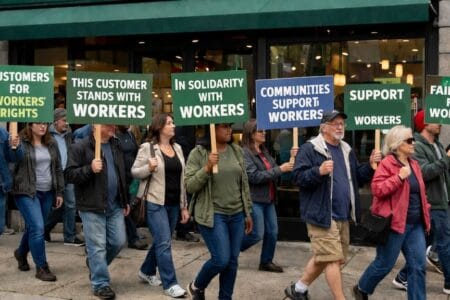
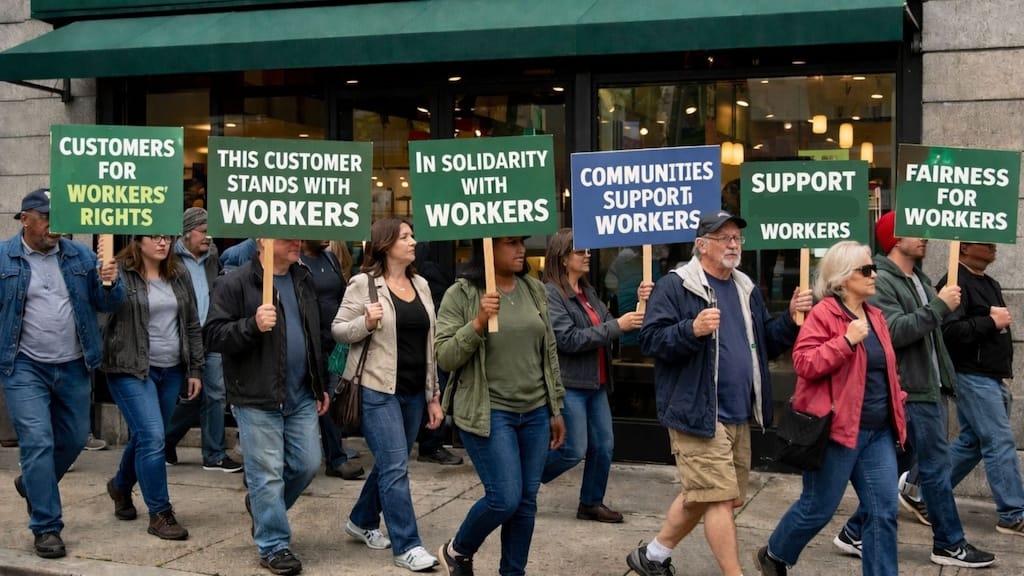
Picket signs on a consumer picket line.
Consumer picket signs work best when they are short, factual, and aimed at corporate policy—not workers or fellow customers.
At the end of this article, there is a list of possible slogans. You might use them on your Pickett signs. But here are some words of caution.
To stay lawful and credible, consumer picket lines generally avoid:
- claiming to represent workers or unions
- blocking or coercive messaging
- threatening language
For example, avoid:
- “WE SHUT THIS STORE DOWN”
- “STRIKE UNTIL—” (unless you are workers)
- “CROSS THIS LINE AND—”
Consumer Picket Lines and the Broader General Strike
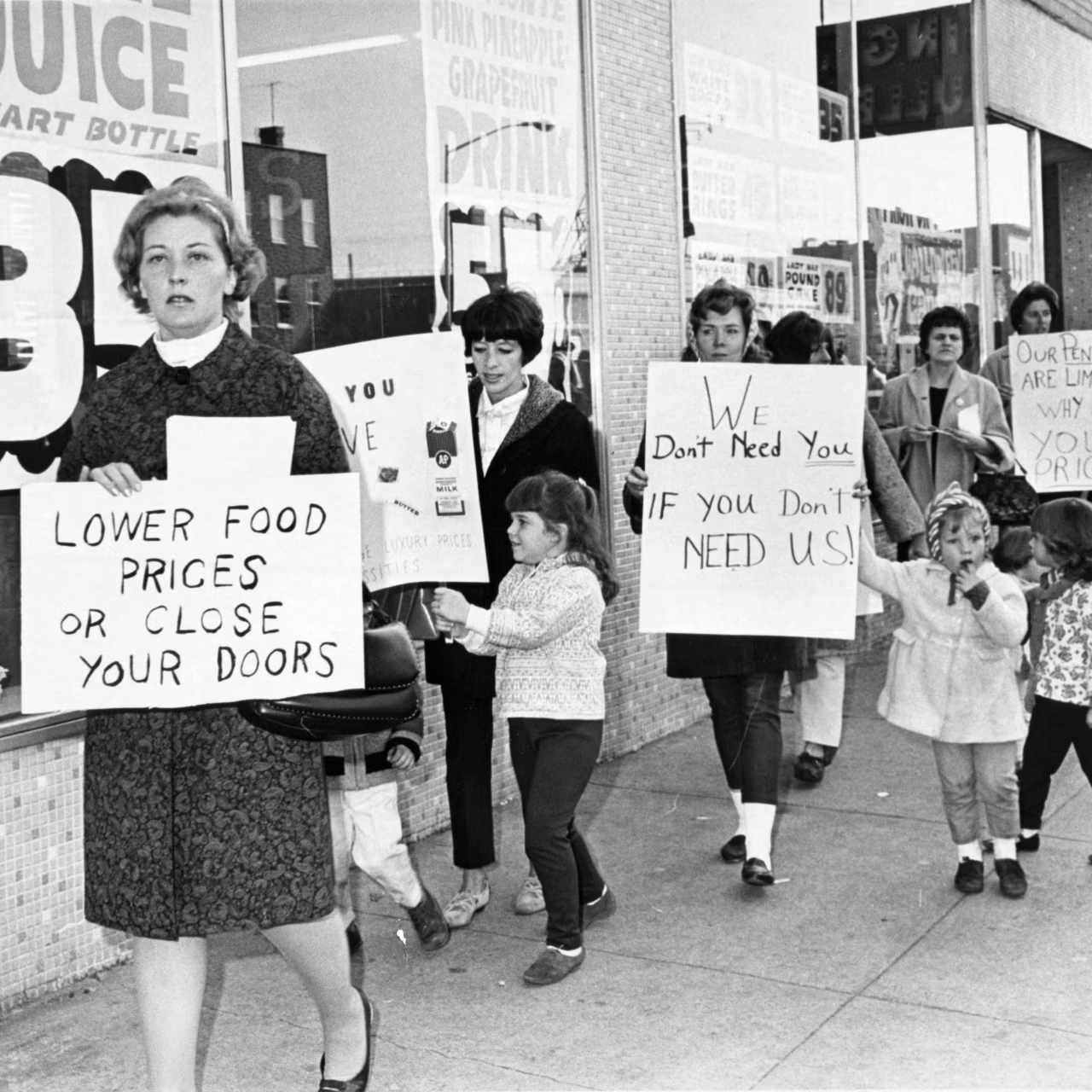
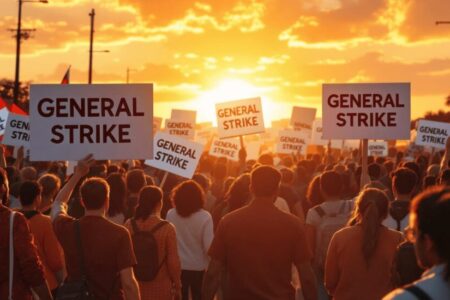
A general strike is often imagined as a single dramatic event. In reality, it is a process that unfolds over time through protest, labor union activity, mutual aid, and public participation, or, as in this case, non-participation.
The general strike is only effective when it affects the bottom line.
Consumer picket lines do not replace labor strikes; they operate alongside them.
They allow:
- Public visibility when labor action is uneven
- Community participation without worker risk
- Pressure directed at corporate leadership
- Practice in coordinated, peaceful protest
In this sense, consumer picket lines serve as support infrastructure for a broader general-strike ecosystem.
Why the Starbucks Workers Strike Matters to You
Historically, periods of strong unionization have been associated with lower income inequality across the economy, and that is good for people everywhere.
Union contracts often set higher baseline wages for a job category. Employers competing for the same labor pool must raise pay to attract and retain workers, even if they are non-union.
Once these benefits exist in one workplace, they become benchmarks that workers elsewhere expect and demand.
Strong union contracts serve as the infrastructure of the labor market. Even workers who never join a union often benefit from:
- Higher pay
- Safer workplaces
- Better benefits
- Stronger legal protections
Picket Lines as a Tool for Local Organizations
Consumer picket lines are not only expressions of individual protest but also tactical options for local organizations, community groups, and grassroots networks responding to current events. They are also a good tool who are read, now, for a General Strike.
Local communities are often the first to witness the effects of corporate decisions: sudden layoffs, union resistance, store closures, or retaliation against workers who organize. These decisions, made in a Wall Street boardroom, ripple out like tsunamis through a Main Street economy.
In these moments, a consumer picket line can provide a visible, lawful, and time-tested form of protest that does not depend on employee participation.
For local groups preparing for a general strike, consumer picket lines can:
- Respond quickly to emerging situations
- Keep public attention on workers’ rights
- Apply reputational pressure without interfering with labor negotiations
- Build protest experience and community coordination
Many people are mad as hell and need a way to turn anger into action. This is one way to start the General Strike now.
A Tool, Not a Replacement
A general strike is not built on a single tactic. It emerges from many forms of pressure acting in concert over time.
Consumer picket lines are one such tool. Used responsibly, they allow the public to participate visibly in protest, support labor unions without speaking on their behalf, and remind corporations that their choices are subject to public response.
The labor market does not “own” picket lines as a means of effecting change. Picket lines are a democratic tool, shaped by context, bounded by law, and strengthened by care.
When consumers step onto the sidewalk to protest corporate behavior, they are not pretending to be workers. They are acting as members of the public, exercising rights that enable collective accountability.
Dancing Quail
Getting my “cup of go” at a locally owned coffee shop
P.S. This Is an Un-Game Move
If this challenge resonates, it’s because it reflects a broader truth: participation doesn’t begin when a general strike is announced. It begins when people show up in lawful, sustainable, and values-aligned ways. It begins when people stop playing a rigged game and decide there is a better way.
The Un-Game exists to help people explore those forms of participation and non-participation without pressure, perfection, or the need to take risks they can’t afford. Each challenge is optional. Each action is adaptable. Each step builds confidence and collective awareness.
If you’re looking for a way to stay engaged, learn more, and connect these moments into a broader strategy, you’re invited to explore the Un-Game and join others who are practicing what participation can look like, right now.
Frequently Asked Questions (FAQ)
What is a consumer picket line?
A consumer picket line is when customers or community members peacefully protest a business on a public sidewalk to express opposition to a company’s policies or practices. Unlike a labor picket line, it is not led by employees and is not part of collective bargaining. It is a form of public protest and consumer expression.
How is a consumer picket line different from a labor union picket line?
A labor union picket line is organized by workers and regulated by labor law because it directly affects employment relationships. A consumer picket line is organized by members of the public and is governed by constitutional free speech and assembly rights, as well as local protest laws. Consumers do not represent workers or unions and are not negotiating contracts.
Is it legal for consumers to picket a business in person?
In many cases, yes. Consumers generally have the right to peacefully protest on public sidewalks as long as they do not block entrances, harass workers or customers, trespass on private property, or ignore lawful police orders. Laws vary by city and state, so legality depends on conduct and location.
Do consumer picket lines require permits?
Often, small and stationary protests on public sidewalks do not require permits, but this depends on local rules. Larger demonstrations, marches, or amplified sound may require permits. Lack of a permit does not automatically make a protest illegal, but checking local regulations reduces risk.
Can consumer picket lines support workers without speaking for them?
Yes. Consumer picket lines can express solidarity with workers’ rights without claiming to represent employees or labor unions. Clear language—such as identifying participants as customers or community members—is important to maintain that distinction.
Are consumer picket lines the same as boycotts?
Not exactly. A boycott usually focuses on withholding purchases, often privately. A consumer picket line adds a visible, public element, bringing concerns directly to the point of sale. The two tactics are often used together, but they are not the same.
What are the common mistakes that can make a consumer picket line risky?
The most common problems include:
- Blocking entrances or exits
- Protesting on private property after being asked to leave
- Harassing workers or customers
- Claiming to represent workers or a union
- Escalating confrontations
Staying peaceful, factual, and non-obstructive helps preserve legal protections.
Have consumer picket lines been used successfully before?
Yes. Historical and modern examples include civil rights–era protests at segregated businesses, consumer picketing organized by groups like Consumer Action in the 1970s, and recent demonstrations outside retail and restaurant locations over corporate policies. These actions show that consumers have long used public protest to pressure businesses.
How do consumer picket lines fit into a general strike strategy?
A general strike is not a single event but a process. Consumer picket lines are one supporting tactic that allows people who cannot strike from work to participate in a visible, coordinated protest. They can amplify labor actions, build public awareness, and prepare communities for broader collective action.
Do I have to participate in a consumer picket line to support workers?
No. Participation is always voluntary. Support can take many forms, including learning about the issue, changing purchasing habits, sharing accurate information, or engaging in other community actions. The Un-Game approach emphasizes progress over perfection and respects different levels of capacity and risk.
Picket Sign Slogans
Here are consumer-focused picket sign slogans that would plausibly appear at a consumer picket line outside a Starbucks location.
They’re written to be clear, non-threatening, and focused on corporate accountability rather than on workers or customers.
Direct & Clear (Most Common)
- NO CONTRACT, NO COFFEE
- FAIR CONTRACTS MAKE FAIR COFFEE
- SUPPORT WORKERS, NOT DELAYS
- BARGAIN IN GOOD FAITH
- WORKERS DESERVE A CONTRACT
- COFFEE SHOULD NOT COME WITH EXPLOITATION
Consumer-Framed (Important for Legitimacy)
- CUSTOMERS FOR WORKERS’ RIGHTS
- WE CAN WAIT FOR FAIRNESS
- THIS CUSTOMER STANDS WITH WORKERS
- ETHICAL COFFEE REQUIRES ETHICAL LABOR
- OUR MONEY, OUR MESSAGE
Corporate Accountability (Targets Policy, Not People)
- CORPORATE PROFITS ≠ WORKER DIGNITY
- STARBUCKS CAN AFFORD FAIR CONTRACTS
- RESPECT THE RIGHT TO ORGANIZE
- STOP DRAGGING OUT NEGOTIATIONS
- GOOD BRAND ≠ GOOD PRACTICES
Short & High-Visibility (Good for Passing Traffic)
- NO CONTRACT
- PAY UP
- BARGAIN NOW
- FAIR WORK = FAIR COFFEE
- WORKERS FIRST
Solidarity Without Speaking For Workers
- IN SOLIDARITY WITH STARBUCKS WORKERS
- WE HEAR YOU
- COMMUNITY SUPPORTS WORKERS
- CUSTOMERS STAND WITH LABOR
Calm, Moral Framing (Useful for De-Escalation)
- FAIRNESS IS GOOD BUSINESS
- DIGNITY SHOULD BE STANDARD
- PEOPLE OVER PROFITS
- RIGHTS ARE NOT OPTIONAL
- THIS IS A PEACEFUL PROTEST
–