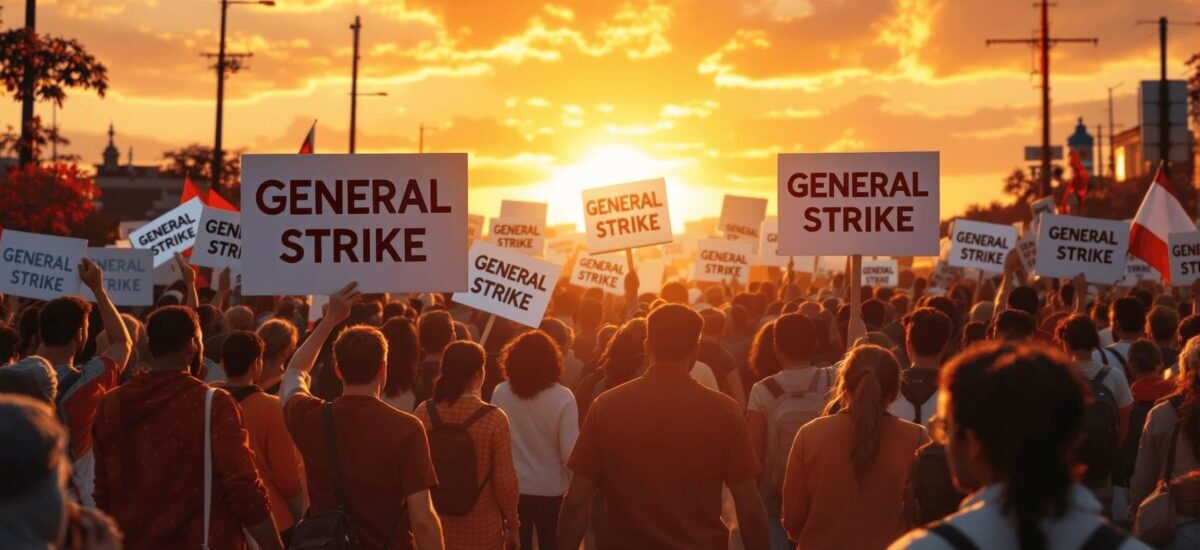
A General Strike, When It Happens, Is Going to Be Difficult By Design. Let’s Get Ready Together!
This is a long-form, foundational article. You do not need to read it all at once. Take what you need, return when ready.
There are those who view a general strike as if it were a day off work or a reality show that would make for good social media content.
We need to be honest with ourselves about what we mean by a general strike.
A general strike is not a day off work. It is not a spectacle. It is not something you will get to watch unfold from the sidelines. If a general strike happens, it will to happen to all of us.
A general strike is a sustained interruption of the systems that shape our daily lives, our work, our spending, our access to essentials. Difficulty is not an unfortunate side effect of a general strike. Difficulty is the mechanism that creates leverage.
A strike without economic consequences is a protest. If it does not create discomfort for those in power, it is not working. A strike with consequences forces redistribution. Applying those consequences will have prices and rewards, and it will not be easy.
This article explains what a general strike is, why it is intentionally difficult, and why preparation, not outrage, determines whether it succeeds.
What A General Strike Really Is.
A general strike is meant to be disruptive, and if it is to succeed, it needs to be impactful.
This needs to be said plainly. A general strike will not be easy. There will be discomfort. There will be uncertainty. There will be pressure to return to “normal.”
A general strike is a deliberate, sustained, coordinated non-participation in the economic systems that extract value from workers in the name of shareholder profits.
When we withdraw our participation together, even imperfectly, the economy does not quietly adjust. It stumbles. COVID-19 proved that. Businesses that depend on predictability feel uncertainty. Systems that rely on constant throughput slow down. That slowdown is not accidental. It is the point. A general strike works precisely by disrupting expectations that have gone unquestioned for decades.
Many employers are insulated from the cost of turning people into profit, and a general strike is an attempt to impose economic costs through labor shortages, disrupted supply chains, lost consumer revenue, and market uncertainty.
Imagine an Extended General Strike
To understand why preparation matters, we have to stop thinking in terms of days and start thinking in terms that remind us that the disruption we are creating will effect us too.
Weeks Without Predictable Income

Imagine not just a moment of disruption, but weeks… or longer. Missed paychecks begin to pile up. Access to essentials becomes less reliable. Store shelves thin out. Supply chains slow. What was once automatic now requires planning, coordination, and mutual support. Stress rises as uncertainty settles in, not only from employers or media narratives but also from within households and communities.
The pressure will not be evenly distributed, and the system will push back, waiting, adapting, and encouraging people to quietly return to “business as usual”. None of this means the strike is failing. It means it is working. The real challenge is not courage in a single moment but endurance over time.
Discomfort isn’t failure; it is leverage.
The difficulty of a general strike is not a flaw. It is evidence that pressure is being applied. Any promise of a painless general strike is dishonest.
Short actions are easier to romanticize than long ones. Extended non-participation is harder. But if all of the truck drivers go on strike, how long do you think it will be before your grocery store shelves are empty? This is what disruption looks like when it reaches ordinary people; not as theory, but as daily reality.
When we imagine an extended general strike, we are forced to confront how tightly our survival is tied to systems we neither designed nor control. Food and medicine do not appear magically. Energy does not flow automatically. Houses don’t build themselves. Labor is the invisible thread holding everything together. When that thread is pulled, even slightly, the system’s fragility becomes visible.
That visibility is uncomfortable, but it is also clarifying. This is the difference between watching disruption and creating it.
When Our Lives Are Treated Like a Revenue Stream
Does it seem like the harder you work, the farther you get behind? Put in extra hours and lose time with the kids. Prioritize the family, and your paycheck pays the price.
This is an economy that demands everything and gives little back. We are not striking against effort, contribution, or responsibility. We are striking against systems that consolidate power upward and externalize harm downward.
I understand paying a profit margin on an iPhone, but not on insulin. We are striking against an economic model that treats life essentials as a captive market.
Housing, healthcare, food, water, and energy are no longer shared necessities. Corporate America has turned them into profit centers designed to extract money from the economy. Last time I checked, that means you and me.
When access to our own survival is contingent on perpetual extraction, participation is no longer voluntary, and withdrawal becomes a necessary act of resistance. – Dancing Quail
A general strike reintroduces choice where none existed.
No requirements, no demands. The information here is a menu of suggested actions, and we get to choose which ones work for us.
There Is a Lot to Do in a General Strike
There are many aspects to a general strike. For many of us, the idea of a general strike is that everyone stops going to work. Some of us think it means going to work, but instead, we are standing out in front with a picket sign.
Coordinated withholding of paid and unpaid labor (including paid labor, gig and contract work, overtime, and unpaid “extra” labor) that keeps systems functioning can have a powerful impact on a business’s bottom line.
When we talk about withholding labor, we are talking about more than clocking in or clocking out. The favors. The flexibility. The emotional labor. The 24/7 availability.
When the invisible effort that keeps organizations afloat are withdrawn collectively, even temporarily, the true cost of operations becomes impossible to ignore.
Paid Labor
When large numbers of workers withhold paid labor, even briefly, businesses feel the impact immediately.
Shifts go unfilled, projects stall, customer wait times increase, and deadlines are missed. Managers are forced to redistribute work, often straining remaining staff to the breaking point or paying overtime to keep basic operations running.
As the strike continues, productivity declines, errors increase, and revenue slows. This type of disruption doesn’t require every worker to walk out; it requires enough people to stop showing up for “business as usual” long enough for inefficiencies to cascade through the system until they reach the bottom line.
A labor strike may not be possible for you. We will be covering the more powerful aspects of a general strike next.
Perfect participation is not required for impact. Partial participation creates uncertainty, which is costly. Businesses plan around predictability. A general strike disrupts that planning.
Some of the most powerful labor is the labor we are never paid for.
Gig and Contract Work
Platforms that rely on gig and contract labor are particularly vulnerable to coordinated non-participation.
When drivers log off, freelancers decline contracts, or delivery workers stop accepting jobs, the service becomes unreliable. The system experiences longer wait times or complete service outages, while still incuring fixed costs, including infrastructure and advertising, and must meet investor expectations.
Because these businesses are optimized for continuous labor availability, even small disruptions can disproportionately impact revenue and public perception.
We are told that flexibility is freedom. In reality, flexibility often shifts risk away from profit margins and onto individuals. A general strike exposes that imbalance by interrupting availability at scale.

Overtime, Unpaid Labor, and 24/7 Availability
Many businesses quietly rely on unpaid labor to stay profitable; employees stay late, answer emails off the clock, or cover extra shifts out of a sense of loyalty or pressure.
When workers collectively stop providing this “extra” labor, cracks appear quickly. Projects slow, managers are forced to confront under-staffing, and labor costs rise as companies must either pay for overtime or accept reduced output.
What was once invisible labor suddenly becomes visible… and expensive.
This is often the safest form of labor strike for many of us. Withholding unpaid labor does not require permission. It simply requires us to stop using our personal time and energy to compensate for systemic shortfalls.
Not everyone can withhold their labor. Healthcare workers, caregivers, and people in precarious jobs may not have that option. That does not disqualify you. Participation looks different for different people, and coordination, not sacrifice, is what creates impact.
The goal is disruption, not martyrdom. We want to interrupt “normal” operations, not perform hardship theater.
You Don’t Have to Jeopardize Your Job to Join a General Strike.
Don’t underestimate the power of “quiet quitting” as a tactic of a general strike. Remember our bottom line: “If you don’t care about my financial bottom line, I won’t care about yours.”
A general strike isn’t a moral purity test. Participation looks different for everyone, depending on your circumstances. What matters is alignment, not uniformity.
The next aspect of a general strike is within reach of everyone, regardless of whether they can withhold labor. These strategies will have the greatest long-term impact on how we do business in America.
Your Voice Matters — But Economic Leverage Magnifies Outcomes
Not being able to withhold your labor doesn’t mean you can’t take part in a general strike.
Speaking up matters. Naming injustice matters. Organizing matters. But corporate power is not persuaded by outrage alone. It responds to incentives, losses, and risk. That risk amplifies our voices.
Every purchase, every subscription, every impulse buy, and convenience choice reinforces or resists the system as it currently exists.
A general strike shifts power by interrupting the flow of money and labor, not just for a day, but for an extended period of time, and if successful, permanently.
Money is not withheld; it is redirected.

By shifting spending away from strike-targeted corporations and non-essential consumption, dollars flow toward local economies, mutual aid networks, and cooperative and community-based systems.
As more and more people prepare, non-essential spending slows or stops.
Money withheld from the “corporate extraction game” captures attention and undermines the leverage of the “life as a subscription” model.
When we change how we spend, we change what survives. Redirecting dollars is slow, quiet, and profoundly effective. It reshapes incentives without asking for permission.
Sustained Participation
The causes we fight against are far greater than the current administration, which is, in reality, an inevitable outcome of the broader political dysfunction fueled by corporate contributions and the elite donor class.
Not everyone can participate in the same way or at the same time.
A successful general strike recognizes that we do not all start from the same place and that we will not all be able to participate in the same way.
This is coordinated individual non-participation, and the emphasis is on the individual. An individual will do (or, in this case, not do) what they can. If you want to do a little more, that’s up to you. Also, an individual doesn’t have to wait for others to get started.
Will a strike last longer than corporate tolerance for loss?
Burnout is not an accident. It is a pressure tactic used against movements. When people are exhausted, isolated, or overwhelmed, they are more easily pushed back into the game of extraction economics.
Some of us have savings. Some of us live paycheck to paycheck. Some of us can step back from work. Others are responsible for keeping people alive or caring for family members. A real general strike does not ignore these differences. It plans for them.
Endurance creates pressure. Like any long-distance endurance challenge, it requires training to complete. But you don’t need to be an Iron Man to run one leg of the race.

Sustainability is resistance. That means pacing ourselves, being flexible with one another, and making room for people to step forward or step back as their circumstances change.
Planning for this reality means expecting movement, not perfection. At times, some of us will need to pause while others carry more weight. That is not failure. That is solidarity in practice.
A lasting general strike adapts to the real lives of those participating. To “run” with the “running” analogy, this is a marathon relay race run by sprinters, milers, long-distance runners, daily joggers, seniors with walkers, moms with strollers and a few kids on bikes… all clearing hurdles, passing batons, and working together to stay the course.
A General Strike Does Not Have a Centralized Leader
A general strike does not emerge without leadership, organization, and sustained effort. The work being done right now by unions, advocacy groups, mutual aid networks, and grassroots organizations is essential. These efforts educate people, build trust, coordinate resources, and create the conditions for collective action.
A general strike, however, is unlikely to begin or sustain itself on a single call or command. History shows that such moments tend to emerge when organized efforts and widespread readiness meet a moment that mobilizes the masses.
Leadership opens the door, but participation carries people through it.
For there to be a mass mobilization of people across the country to participate in a sustained labor shutdown, it will require an impressive event.
When it happens, it will happen fast. We want you to be ready.
We encourage you to find an organization you can work with to help you lay the groundwork for a sustainable future. Check the Solidarity Groups section at Gereralstrike.net
If you are organizing right now, your work matters. General strikes do not happen without the patient, often invisible labor by leaders and organizations laying the foundation. Education, coordination, mutual aid, and trust-building are not optional; they are essential.
And so are you. Thanks!
The Union Crutch
It is important to be clear that most labor unions cannot formally participate in general strike walkouts. Unions are legally bound by collective bargaining agreements that include no-strike clauses, grievance procedures, and defined contract terms. Violating those agreements can expose unions and their members to serious legal and financial consequences.
Union constraints don’t weaken a general strike, they explain why participation takes many forms beyond formal walkouts.
This does not mean union members lack solidarity, concern, or the chance to participate in economic disengagement. It means unions are constrained by the legal framework they operate under, even when broader economic conditions that motivate a general strike directly affect their members.
Research organizations like the Economic Policy Institute have long documented how collective labor action influences wages, working conditions, and economic power.
Unlike a labor union, a general strike has no single organizer who can “call it off,” no headquarters to shut down, and no timeline for returning to “business as usual.” Once the general strike starts, there is no one to negotiate with.
Leaderless does not mean unorganized.
It means coordination emerges from shared conditions within communities rather than from centralized command.
Many groups are successfully organizing, and I applaud their commitment. It is exciting to be involved with these organizations and to see the momentum we are collectively building.

There have been one-day strikes scheduled. I have participated and will continue to participate, but these one-day actions are another form of protest. They do not apply the necessary pressure to cause systemic change.
There have been many calls for a general strike from many people scheduled on many different days. Recent events have sparked more actions and greater participation. Future events and your participation will dictate the success of a general strike.
A general strike doesn’t begin because someone calls it. It begins because enough people can no longer participate in the system as it exists.
We may be quickly headed toward a grassroots general strike firestorm, as the deliberately engineered deterioration of America’s social structure has more and more people saying, “I have had enough.”
Why Participation Is a Personal Choice
Structural pressure explains why a general strike works. Personal choice explains how people survive it. The decision to participate in a general strike is deeply personal.
There is no single profile of who “should” participate in a general strike. There is no checklist you have to pass. Instead, a general strike begins when people recognize themselves in unworkable conditions and respond to them.
Only you can decide when, where, how, and to what extent you participate. Your circumstances, responsibilities, and risk tolerance matter. There is no universal formula that applies to everyone.
A general strike is not something you are assigned. It is something you choose.
For some people, participation may mean withholding labor. For others, it may mean redirecting spending. For others, it may mean supporting mutual aid, sharing resources, or helping others sustain their participation.
Choosing not to participate in one way does not disqualify you from participating in another. A general strike is not about purity or perfection. It is about intentional alignment with your values.
How Solidarity Builds Certainty
Making these choices alone can feel overwhelming. Doubt thrives in isolation.
Solidarity doesn’t eliminate risk; it replaces isolation with shared resolve. When we see others making similar choices at their own pace and in their own way, our decisions feel less fragile and less isolated. Shared participation creates stability even when outcomes are uncertain.
Solidarity is not about everyone doing the same thing at the same time. It is about knowing you are not the only one stepping back, slowing down, or saying no. It is about collective reassurance that you are not imagining the problem or overreacting to it.
When we move together, even imperfectly, our individual decisions feel more grounded. Certainty grows not from guarantees, but from shared purpose.
This certainty doesn’t come from theory. It comes from seeing others take similar steps, in their own way and at their own pace.
How a Strike Works in Practice
Corporate systems are built to outlast people. Large institutions have cash reserves, access to credit, legal teams, and the ability to absorb short-term losses that individuals usually cannot. When pressure arises, their first response is often not to change but to endure.
They delay, deflect, and normalize disruption, betting that everyday people will feel the strain first.
The longer a disruption lasts, the more the burden shifts onto unprepared individuals, and the system relies on that imbalance to restore “business as usual” without making meaningful concessions.
Understanding this is exactly why preparation matters. A general strike does not succeed because people are angrier or louder. It succeeds because enough of us can stay engaged longer than the system expects.
A sustained general strike will expose real vulnerabilities for all of us.
Missed or delayed income, food insecurity, housing instability, and healthcare access concerns are common during an extended strike.
Without preparation, people are forced back into participation; not because they stopped believing, but because survival demanded it.
All of this can seem overwhelming, but it doesn’t require a radical break from daily life. It starts with small, deliberate changes that reduce pressure points over time.
A general strike isn’t withdrawal from the economy; the goal is to build a sustainable economy: learning how to thrive, adapt, and redirect resources in beneficial ways that can be sustained over time.
Small, individual shifts, when practiced together, compound into collective leverage without requiring anyone to risk their livelihood unnecessarily.
But if it comes to the point where you want to make that choice, will you have the option to do so? That’s why I created tools designed for real life, mine.
Preparation Determines Whether a General Strike Succeeds
Over the past year, I realized that belief alone isn’t enough. Without structure, preparation becomes overwhelming, and momentum fades.
I have consciously and significantly redirected my personal spending toward companies aligned with my values that also benefit my community. We’ve stocked the shelves and tightened the budget.
Other things we done include:
- building a small financial buffer by
- reducing reliance on non-essential subscriptions
- identifying local food networks
- defining personal risk limits
I don’t think we have everything, but it’s good to know we have something. That helps a lot with our mental health.

We did this because history tells us what to expect: as late-stage capitalism struggles to maintain control, things will get worse before they get better. It’s like the person who’s winning at Monopoly trying to convince everyone to keep playing. After a while, it’s just no fun, and it’s time to play a new game.
The simple actions that helped me and thousands of others have been effective tools for preparation. More importantly, we have already started our individual general strikes, and we want you to join us.
It’s Not a Big Spectacle, but It Is a Big Deal.
You Won’t See Masses, but It Will Be Massive.
Imagine the power of hundreds of thousands of citizens, all moving through the economy en masse, with intention and deliberate action designed to cause economic change.
“The Un-Game” is a FREE 30-day, simple-to-use scavenger-hunt-style game designed around a series of simple actions that affect your budget, disengage you from exploitation, and, collectively, help build a strong middle class.
“The Un-Game” turns overwhelming change into manageable daily steps through small, intentional actions that fit into real life and gradually compound into meaningful economic leverage, enabling you to participate without burnout and to build confidence and momentum over time.
This game is great to play alone. It is even more amazing when played with others. We encourage you to play “The Un-Game” with your solidarity group and grassroots organization to take collective action as we build momentum together.
If the game isn’t working for you, maybe it’s time to play a better game!
Where The Un-Game Builds Momentum, The Survival Guide Reduces Risk.
I wrote “The Survival Guide for a General Strike” and the content on GeneralStrike.net as an outlet for my anger. Some of the benefits of doing so are that it has helped me keep my sanity, as I have distilled all of this craziness into a few simple actions I can take to retain my liberties and freedom.
It developed into the plan that my family, as well as thousands of others, have implemented as preparation for the coming uncertainty.
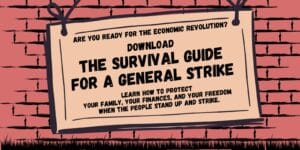 If you are considering participating in a general strike, even partially, preparation is important.
Preparation shifts the balance by reducing the pressure points that force people back into participation too early. When access to food, housing, healthcare, and income has been carefully considered in advance, choices feel less desperate and more intentional.
That is what preparation provides: not certainty, but options. Having options is what allows participation in a general strike a real choice rather than a short-lived reaction.
It turns fear into agency and narrows the gap between pressure and change.
The Survival Guide provides practical tools for sustained participation in a general strike, helping you reduce personal risk, maintain access to essentials, and make informed choices about how and when to participate, so you are not forced out of action before you are ready.
Download the FREE “Survival Guide for a General Strike”
This guide is not about perfection. It is about sustainability.
No hype. No guilt. Just tools.
GeneralStrike.net as a Resource Tool.
- GeneralStrike.net is a living toolkit for participation. Each section is designed to help us move from awareness to action at our own pace and capacity.
- General Strike 101 offers clear, plain-language explanations that cut through myths and misinformation, helping you understand what a general strike is, how it works in practice, and what participation realistically looks like, so your actions are grounded in reality rather than hype or fear.
- Solidarity Groups connects you to aligned movements, campaigns, and organizing efforts, giving you a broader sense of shared purpose and helping you see how your individual choices fit into a larger collective effort, thereby strengthening resolve and reducing isolation.
- Resources brings together tools, educational materials, and shared knowledge, including “The Un-Game” and “The Survival Guide for a General Strike”, to build long-term resilience so you can adapt to changing conditions, support others when needed, and continue participating in ways that align with your values and circumstances.
GeneralStrike.Store has all your strike gear

GeneralStrike.store exists to support the work. The products available at GeneralStrike.store help us fund education, tools, and infrastructure while openly reflecting our values. Every item is designed to spark conversation and support the movement without feeding corporate extraction.
Through affiliate opportunities, mutual aid groups and grassroots organizations can also use the store as a tool to fund their own local work and community support efforts.
Mass Movement Move Farther Together
If you are still with me, you know it is true. The current system needs to change. I’m unsure whether the change will be gradual, peaceful, and painless or a catastrophic disruption of the American way of life. I do know that if I prepare for the latter, I will thrive in the former.
And if we do it together: Republicans, Democrats, and Independents; Christians, Muslims, and Jews; humanists, atheists, and agnostics, we can turn our individual activism and isolated impact into nurturing creative partnerships, build broad coalitions, and link arms with our neighbors to replenish the land of the free and rebuild the home of the brave, from sea to shining sea.
In reality, a general strike will start when you do and ask someone else to join you.
Because a general strike is not a moment.
It’s a process.