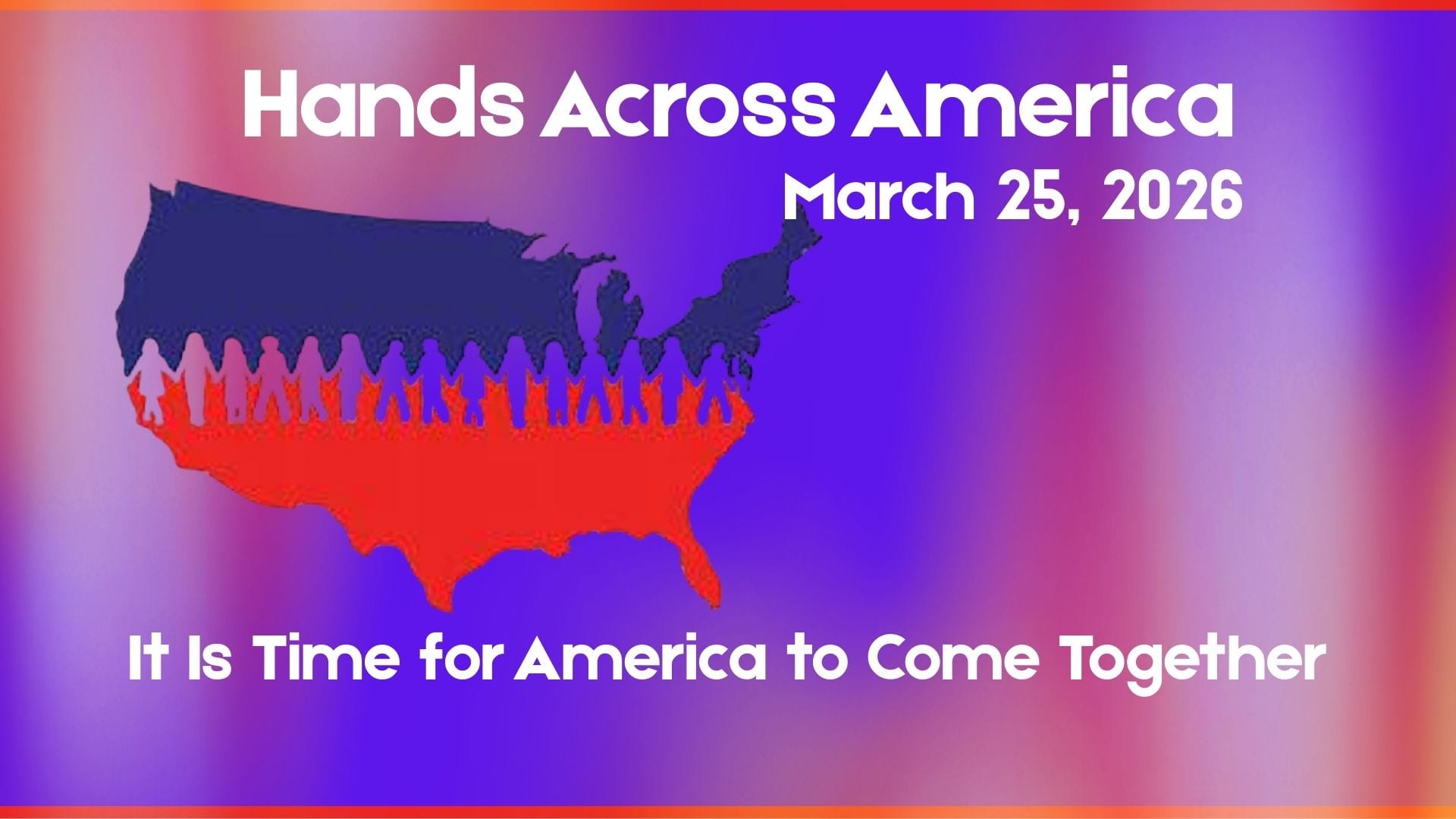
In May 2026, communities across the United States are planning a modern reimagining of a historic moment of collective action: Hands Across America 2.0. Scheduled for Memorial Day, May 25, 2026, the event is being described by organizers as a symbolic, peaceful demonstration of unity amid deep economic, political, and social strain.
The original Hands Across America took place in 1986, when millions of people joined hands across the country to raise awareness of hunger and homelessness. Although the event’s logistics were imperfect, its visual impact was powerful: ordinary people, in unmistakable physical form, showed that solidarity could cross state lines, identities, and differences. Forty years later, Hands Across America 2.0 draws on that same symbolic language, connection, presence, and shared purpose, reframing them for current conditions.
Hands Across America 2.0 is a Grass Roots Movement
Unlike a traditional protest or strike, Hands Across America 2.0 is being framed primarily as a coordinated act of public solidarity. Participation is intended to be nonviolent, lawful, and accessible. Local groups are encouraged to organize small gatherings, sometimes only a few dozen people, rather than attempting to form a single continuous line across the country. The emphasis is not on recreating the original event literally but on echoing its intent: visible unity amid widespread disconnection and economic pressure.

The event is being promoted through grassroots channels, community calendars, and online organizing hubs. It has been listed on national activist websites as a community event rather than a formal political action, and the promotion so far appears decentralized. There is no single list of demands attached to the event, nor is it tied to a specific political party, union contract, or legislative outcome. Instead, it serves as a marker moment, a shared date when people across the country choose to be publicly present together.
For groups focused on economic justice, labor rights, and democratic participation, Hands Across America 2.0 occupies an interesting middle ground. It is neither a general strike, a boycott, nor a shutdown. At the same time, it aligns with a broader pattern of coordinated non-participation and collective visibility that many grassroots movements pursue. In that sense, the event can be understood as part of a growing ecosystem of actions that prioritize scale, symbolism, and coordination without requiring uniform tactics.
How to Get Involved with Hands Across America 2026
From an informational standpoint, Hands Across America 2.0 is a nationally synchronized grassroots action with a clear date, a low barrier to entry, and a strong historical reference point. For individuals and organizations tracking upcoming civic actions, whether labor-focused, community-based, or symbolic, it stands out precisely because it does not require full alignment or pose any risk. Participation can range from attending a local gathering to simply acknowledging the moment.
Because Hands Across America 2026 is a decentralized movement of people just like you and me, there is no organization at this time who is spearheading the information. but as we all know, if you go to your social media, pages and search Hands Across America, you will start to get enough information for you to find out how you too can participate in this event.
As with many decentralized actions, the ultimate impact of Hands Across America 2.0 will depend on its adoption and how communities choose to contextualize it locally. What is clear now is that it has secured a place on the 2026 civic calendar as a shared moment of reflection, visibility, and collective presence; one that reflects a growing appetite for national actions that are cooperative rather than confrontational.
This article is provided for informational purposes only. Inclusion of events or organizations does not imply endorsement or affiliation.