When Basic Survival Becomes a Recurring Bill
The Subscription Economy You Can’t Cancel
There is nothing inherently wrong with subscription models.
Paying monthly for music, movies, software, or cloud storage can be convenient and predictable. In many cases, subscription models make tools more accessible and spread costs over time.
But a quiet shift has taken place.
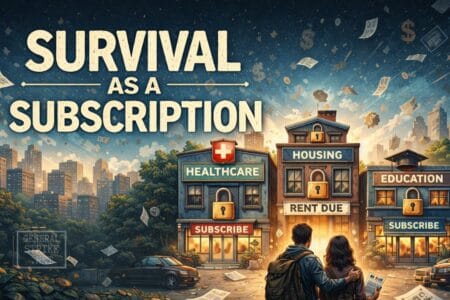
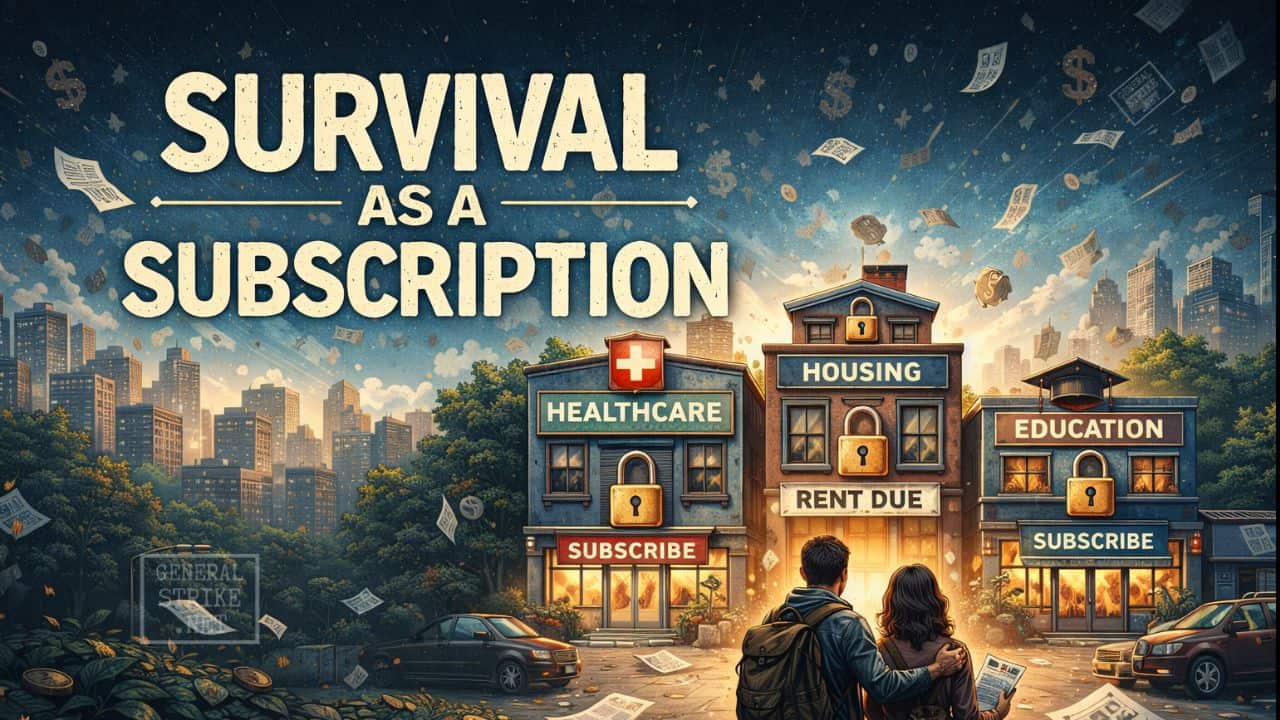
Increasingly, the most essential parts of life, including healthcare, education, housing, and food, function less like one-time needs and more like recurring obligations. They arrive not as optional services but as continuous payments required to participate in modern life.
For many households, this creates a subtle yet persistent tension: every dollar is spoken for before it is earned. Budgets become rigid, and flexibility disappears. The future begins to feel like a continuation of today’s obligations rather than an open horizon.
The issue is not whether companies earn profit margins on luxury goods or convenience services.
The deeper tension emerges when survival itself carries a margin.
When insulin, rent, tuition, and groceries feel like unavoidable recurring charges, daily life can resemble a subscription, one you cannot cancel without consequence.
This article explores that nuance:
- How survival costs mirror subscription models
- why it creates financial and psychological strain
- and how individuals can respond personally, locally, and civically
The Subscription Economy and the Illusion of Choice
The subscription economy thrives on predictability. Companies gain stable revenue, and consumers gain ongoing access.
But subscription logic changes when applied to essentials.
Optional subscriptions involve choice. Survival subscriptions often involve compliance.
A streaming service can be canceled. Housing cannot. Education debt follows for decades. Healthcare costs can’t be postponed indefinitely. Food prices affect every household weekly.
Over time, this dynamic produces more than financial strain; it also produces psychological fatigue. The feeling of constantly managing access to basic needs replaces the sense of building toward stability. Many households begin to experience progress not as advancement but as maintenance.
The Social Implications of Subscription Living
When Survival Feels Metered
For millions of people, the pressure of recurring survival costs creates a sense that life itself is metered.
This metering shows up in subtle but powerful ways:
- Medical debt affects roughly 1 in 5 U.S. adults
- Rent burden impacts nearly half of renters
- Student loan balances average tens of thousands per borrower.
- Grocery costs are rising faster than wages in recent inflation cycles
These experiences create financial stress and emotional strain, as well as uncertainty about stability, delayed milestones, and a constant background calculation of affordability.
The concern is not simply about price levels. It is the combination of inevitability, repetition, and limited alternatives that creates a sense of being locked into participation.
The opportunity for personal ownership is lost in a subscription economy.

The Four Survival Subscriptions
Healthcare: The Cost of Staying Alive
Healthcare is one of the most emotionally charged forms of survival subscription.
Medical debt, including prescription affordability, remains a leading driver of financial hardship. For many families, the lived reality involves navigating cost uncertainty while managing health needs, sometimes resulting in crippling debt, delayed medical care, or difficult trade-offs that are too often life-or-death decisions. No one should be denied lifesaving medication because of cost.
Beyond the financial burden lies a deeper psychological pain point: the fear that illness could destabilize everything. For many, healthcare costs are not just a bill but a background anxiety about vulnerability.
Education: Opportunity with a Long Tail
Education promises mobility but often delivers obligation.
Student loans extend the timeline to financial independence and shape life decisions long after graduation. The psychological weight of long-term debt can influence career risk tolerance, geographic mobility, and even identity.
The pain point is not merely repayment; it is the feeling that opportunity comes with prolonged financial pressure.
What will we do as a nation when Artificial Intelligence replaces the jobs that are needed to repay these loans?
Shelter: Housing as a Permanent Payment
Shelter is the most fundamental survival cost, yet increasingly the least secure one.
Rent as a perpetual payment creates a sense of financial stagnation. Homeownership barriers create a sense of exclusion from wealth-building pathways. Institutional investors have added further barriers to entry.
Housing instability creates emotional stress that permeates work, relationships, and mental health.
The emotional reality is not an economic issue; it is an existential one: Shelter is not optional, and instability has profound consequences for society.
Food: Consolidation and Cost Volatility
Food represents both survival and dignity.
Food represents both survival and dignity.
Price volatility forces constant recalibration. Nutritional trade-offs create health implications. Consolidation reduces resilience and local alternatives.
Food stress manifests not only at checkout lines but in family dynamics, health outcomes, and long-term well-being.
And since we already pay for clean water, one can’t help but wonder, half-jokingly, whether clean air will one day be offered as a premium add-on to your “American Life Subscription”.
An absurd idea, I know… unless it isn’t.
Additional Examples of Survival by Subscription
Each additional survival subscription reinforces the same emotional pattern: stability tied to ongoing payment.
- Transportation becomes access rather than ownership.
- Utilities become participation infrastructure.
- Connectivity becomes a prerequisite to opportunity.
- Insurance becomes conditional security.
- Childcare becomes a prerequisite to employment.
- Banking becomes a gateway with fees attached.
The shared pain point is dependency; stability feels conditional rather than guaranteed.
Lifestyle Subscriptions.
Not all subscriptions relate to survival. Many reflect belonging and identity.
But layered atop survival obligations, lifestyle subscriptions create pressure, the subtle fear of falling behind socially, culturally, or professionally.
This emotional tension contributes to subscription fatigue, where financial decisions become intertwined with identity and participation.
When layered on top of survival subscriptions, lifestyle subscriptions contribute to subscription fatigue in a continuous drift towards a subscription economy.
Subscription Fatigue and Financial Drift
Financial drift rarely happens all at once. It accumulates quietly through small, recurring charges that feel insignificant in isolation but meaningful in aggregate. A streaming service here, a productivity app there, a membership renewal you meant to cancel. Each charge is barely noticeable on its own.
Over time, automated payments reshape monthly budgets, turning flexibility into obligation. What begins as convenience becomes a constraint.
This slow accumulation often leads to a subtle yet persistent emotional strain known as subscription fatigue.
Many people describe a sense of losing control over their financial landscape, not because of a single expense but because of the constant hum of recurring charges that demand attention, justification, and upkeep. This moment of awareness, often triggered by an audit, becomes a turning point.
Tools like Rocket Money can help identify recurring charges and expose hidden expenses. While not a complete solution, awareness is often the first step toward reclaiming control, and that moment of awareness opens the door to deeper reflection on participation, choice, and the redesign of financial habits.
The Great Unsubscribe (The Un-Game Connection)
GeneralStrike.net provides FREE practical resources for anyone seeking to reduce dependence on the “survival-as-a-subscription” economy.
The Un-Game is one of those pathways, a series of small daily actions that build awareness, reclaim choice, and redirect your personal economy toward greater stability and intention.
Within the 30-Day Disengagement Challenge, the first step is The Great Unsubscribe.
This is not about deprivation. It is about clarity.
Participants often discover:
- immediate savings
- reduced digital clutter
- confidence in financial decision-making
- renewed awareness of where choice exists
The deeper insight is that while discretionary subscriptions can be redesigned individually, survival subscriptions often require broader conversation and collective action.
The Un-Game is a great game for organizations to play, amplifying the impact of our actions, fostering community, and building momentum for grassroots organizations.
Mini Actions: Redesigning Participation
Consider these small steps as awareness exercises:
- Audit discretionary subscriptions
- Cancel or rotate one service
- Calculate your housing cost as a percentage of income
- Provide the price of one medication or insurance cost for awareness.
See if your prescription is on Cost Plus Drugs - Track grocery spending for one week
- Call a representative about essential affordability
- Join a local conversation on housing, healthcare, or education
These steps, similar to the challenges in the Un-Game, progress from personal awareness to civic participation and build momentum rather than demanding perfection.
Civic Action and Structural Change
Many individuals engage legislators to address affordability challenges across healthcare, housing, education, and food systems.
Legislative pathways to affordability can be complex and gradual. Yet history shows that economic behavior and collective pressure often shape policy discussions.
Periods of sustained cost pressure have historically coincided with labor movements, policy reforms, and public dialogue about economic structure.
Understanding this context does not require agreement with any single tactic. It simply recognizes that when survival feels economically constrained, people pursue multiple pathways to influence outcomes, which explains why collective economic action remains part of civic discourse.
Conclusion: Survival Through Awareness and Participation
The subscription model is not inherently harmful. It can offer convenience, predictability, and access.
But when survival itself feels subscription-like, awareness becomes essential.
- Every recurring payment reflects participation in a broader system.
- Every audit yields insight.
- Every conversation builds momentum.
The goal is not withdrawal from modern life. It is intentional participation, deciding where choice exists and exploring collective pathways where it does not.
Dancing Quail
Thriving towards an economy that works for everyone
A personal note: the recommendations and strategies in this article, in the Survival Guide for a General Strike, and the Un-Game are the exact practices that have been implemented by the author. By reducing my automatic subscriptions (even some that I liked) I have been able to redirect those funds towards more sustainable efforts.