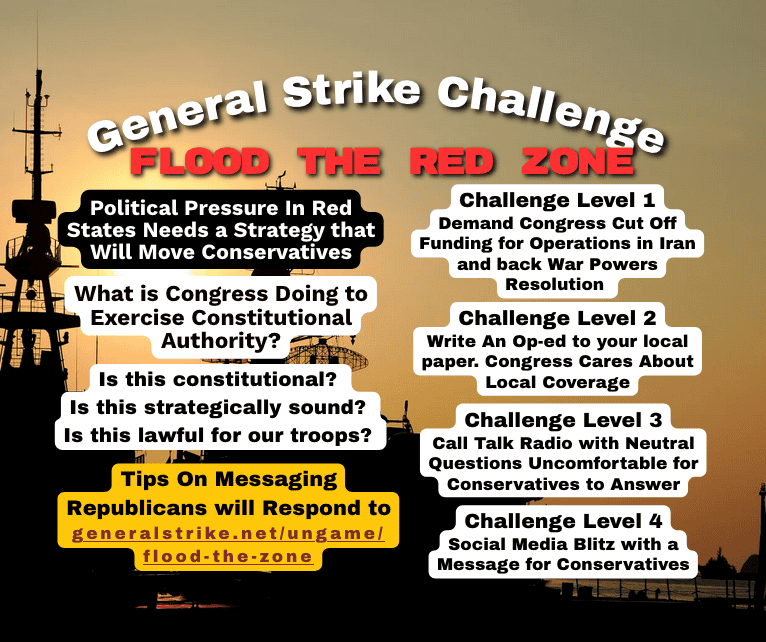
How to Speak About War Powers in Ways Conservatives Will Hear
Articles of impeachment have been filed. Democratic support is growing. As happy as many of us are to hear this, the reality is we are not even close to getting a vote in the House.
As of this writing, 85 representatives have publicly supported the articles of Impeachment. Democratic leadership is hesitant. Republican support is absent. And even with a handful of republicans supporting the articles, it is unlikely even to make it to the floor.
Calling for Impeachment is a full stop to Republican ears and it hasn’t landed in Democratic leadership. Yet.
Maybe We Need a New Strategy.
This is not left vs right. That is proving to be an unsuccessful strategy. We need to move past politics and protect the process and the rule of law. Since the base that needs to shift is conservative, maybe we need to start Broadcasting the conservative message.
- Is this constitutional?
- Is this strategically sound?
- Is this lawful for troops?
- Why is Congress not exercising its constitutional authority?
- The precedent we set today will be with us for a very long time.
These are conversations that can engage Republicans in discussions of presidential restrictions that could lead to impeachment.
Our Challenge Today. Flood the Red Zone with Messaging that matters to Conservatives.
If ever there was a time for a full court press it is now.
Historically, Republicans only break when multiple conditions stack at once:
- Clear constitutional violation: like a sustained military action without authorization
- Credible internal voices speak first. Retired military leaders, conservative legal scholars, and right-leaning media have begun questioning.
- Public opinion shifts: Republican voters start wavering
- Leadership cracks. A few senior Republicans signal openness, allowing others to follow
One and two above are in place. Three and four are starting to happen, and we have an opportunity to build momentum behind the cracks in support. That means a full court press
Challenge option 1: Call your Representative and Senators.
- Especially if they haven’t declared a stance on this issue.
- Above all, stick with a topic that has traction.
- Tips for speaking to red state representatives here.
Challenge Option 2 Write an Op ed in your local Paper
Local Media is underrated when it comes to political influence.
- Local newspapers (letters to the editor)
- Local TV stations (get a reporter to cover your question as a story)
- Regional radio news (call in to shows – write producers requesting a coverage)
Local media amplifies clear, relatable questions people are already asking. Members of Congress care more about local coverage than national noise
Challenge Option 3 Call In to talk Radio
- Local conservative talk radio shows
- Regional political shows
- Drive-time call-in programs
Call in with: One clear question – Calm tone – No ranting. No lead in – then listen. If your question is good, it will be more powerful than the answer that follows.
Good questions shapes listeners’ perceptions.
More on Asking good questions below.
Challenge Option 4 Flood social media with links to conservative voices
- Legal scholars say, “This may be illegal.”
- Military voices say, “This could be unlawful orders.”
- Ethical voices say, “This may not be a justified war.”
- Conservative Commentators
Questions, Topics and tips for social media posting below:
Why This Matters
If your goal on social media is to sway conservative thinking, then what works in our echo chambers will not even enter into theirs.
People tend to respond more strongly to messages that align with their core values and belief systems. We evaluate information through what we prioritize. This frames our worldview. The same issue can be understood in different ways through different world views.
- Europe views this through the lens of alliance stability
- The Middle East questions the escalation and legitimacy,
- The US Media discusses this issue in terms of constitutionality and political viability.
But, conservative media is not engaging deeply with Article I war powers arguments, legal scholar warnings, or military law concerns. That absence prevents the issue from gaining constitutional legitimacy within their audience.
They are delegitimizing the impeachment effort itself, framing this as a political stunt or partisan theater. If we push: “Impeach the president”, we trigger an immediate partisan shutdown.
What they are asking is “Does this serve U.S. interests?”, “Is this escalation necessary?”
A growing number of legal scholars, military officials, and constitutional experts are speaking up
Even traditionally aligned voices in Conservative media are questioning the policies. Influential voices inside conservative echo chambers have raised concerns or skepticism:
- Tucker Carlson criticized the direction of the war and its escalation.
- Mark Levin criticized elements of the ceasefire deal, expressing policy-based dissent rather than an anti-war framing.
- Megyn Kelly defended party loyalty, but her discussion itself shows the internal tension.
A growing number of legal scholars, military officials, and constitutional experts are speaking up.
- Former Air Force legal advisor Rachel VanLandingham warns about the risks of civilian targeting and the legal ambiguity in operations.
- Retired Admiral Michael Smith, Retired General Shawn Harris, Retired Army attorney Gary Corn, and other military leaders are saying these threats may constitute ‘likely war crimes” and concerns about unlawful orders during escalation.
- Rand Paul, a longstanding critic of Unauthorized wars and executive overreach, supports congressional war powers limits.
- Thomas Massie pushed for a war powers resolution and represents a constitutional conservative position.
- Military-aligned ethical leadership has raised concerns that the conflict may not meet “just war” standards.
- Questions exist around necessity, proportionality, and civilian protection.
Tips for Posting on Social Media
Social Media Strategy 1: Flood the zone with structured, evidence-based framing.
- Constitutional scholars (especially conservative voices)
- Former military/legal official
- Clear focus: war powers, authorization, constitutional duty
- Some links above, More are below. Please post others in the comments.
Social Media visibility in the right places:
Asking questions on public officials’ accounts, commenting on local news posts, and posting in community Facebook groups are effective ways to deliver targeted messaging to all sectors of our community.
Social Media Strategy 2: Pick one clear question on an issue that will get conservatives thinking, not reacting
Choose something simple and neutral, for example:
“What is Congress doing to exercise its constitutional authority over war?”
Place it in 3 to 4 places
- Comment on a local news post
- Post in a community Facebook group
- Reply on your representative’s official page
Keep it calm, concise, and respectful.
Avoid piling on threads or repeating in the same place
Engaged don’t argue. Ask one follow-up (“What would that look like?”). Thank people for specific answers. Ignore or move on from unproductive exchanges.
A list of other engaging and follow-up questions can be found below.
What will likely not work.
- Impeach now.
- War crimes (as an opening argument)
- Personal attacks on the president
- Emotional or accusatory language
Current issues are challenging people’s group identity. Which approach will help remind them of what is important? No matter how you feel about the past, they will need to view the issue through their lens, and you could bring the conversation to them in a way they will hear.
Topics That Will Work
Constitutional Authority
- Congress has a responsibility under Article I.
- Congress, not the president, has the power to authorize war
- That responsibility should be clearly exercised, not assumed
Limiting Government Power
- Unchecked executive power expands government authority
- The powers used today apply to future presidents, too
Supporting the Military
- Service members deserve clear, lawful missions
- Authorization and oversight protect troops as well as civilians
Accountability & Oversight
- Congress has a duty to ask questions and provide oversight
- Silence can function like approval
Precedent Matters
- Decisions made now shape what becomes normal later
- Constitutional boundaries only hold if they are used
Calling a Red State Representative
If you are calling your representative in a Republican district, do not demand impeachment directly. By directing them onto constitutional terrain, impeachment becomes a logical next step. Local constituents calling the office turn a national issue into a home-district accountability issue.
If you want your Representative to take action on an issue, speak in ways they will listen to.
Staff track call volume and themes daily. This is a primary input for Congress. If you ask a question, they will likely respond.
“Hi, I’m a constituent. I’m calling to ask what the Representative is doing to exercise Congress’s constitutional authority over war.”
- “I’m concerned about maintaining proper checks and balances.”
- “I’d like to understand what oversight is happening.”
- “What steps is the Representative supporting?”
- What actions are being taken to uphold Article I war powers and ensure accountability?
Keep the conversation calm, respectful, and curious. Focus on responsibility, not blame. Ask questions:
Start with clarity (low-friction openers)
- “How is this issue being handled right now?”
- “What steps are currently in place?”
- “Who is responsible for oversight on this?”
- “What role is Congress playing here?”
Focus on process and responsibility
- “What is being done to ensure constitutional roles are being followed?”
- “How is oversight being exercised in this situation?”
- “What mechanisms are in place for accountability?”
- “How are decisions like this reviewed or authorized?”
Invite specifics (move past generalities)
- “Can you point to any recent actions or votes on this?”
- “What committees are actively working on this right now?”
- “What has the Representative supported or opposed so far?”
- “Are there any upcoming actions planned?”
Invite specifics (move past generalities)
- “Can you point to any recent actions or votes on this?”
- “What committees are actively working on this right now?”
- “What has the Representative supported or opposed so far?”
- “Are there any upcoming actions planned?”
Grounded in practical impact
- “How does this approach ensure clarity for service members?”
- “What safeguards are in place for those directly affected?”
- “How are risks being evaluated and managed?”
- “What outcomes are being prioritized?”
Shift toward solutions
- “What options are being considered right now?”
- “What would meaningful action look like from Congress?”
- “What steps could be taken to strengthen oversight?”
- “What would need to happen for Congress to act more directly?”
Explore accountability
- “How will the public know if this is being handled appropriately?”
- “What reporting or transparency is available?”
- “How can constituents stay informed on this issue?”
- “Who can follow up if there are no clear answers?”
Look forward (future-focused)
- “What precedent does this set going forward?”
- “How can this be handled better in the future?”
- “What lessons are being considered right now?”
- “How do we prevent confusion around authority next time?”
Close the loop (end strong)
- “Can I receive a follow-up with the Representative’s position?”
- “Where can I see this addressed publicly?”
- “Who should I check back with on this?”
- “When would be a good time to follow up?”
Simple Version for Calling your Representative.
- “What is being done right now?”
- “What specific actions has the Representative taken?”
- “What steps are being considered next?”
The Art of Good Questions
Shallow questions get opinions. Specific questions get people thinking. Structured questions get answers you can actually use. Here are some examples of structured questions
At what point should Congress be required to authorize or limit military action, and has that point been reached here?
What evidence is Congress using to evaluate this situation, and how is that oversight happening in practice?
Who is responsible for making sure this is handled within constitutional limits, and how do we know that’s happening?
If Congress decides this hasn’t been properly handled, what specific action can or should it take next?
Notice these questions do not reveal a political ideology. They address the issue neutrally. The way it is framed doesn’t allow it to be discounted.
There are more questions to start productive conversations below
How To Use These Effectively
- Ask one or two questions, not all of them
- Let them answer, don’t rush to fill the silence
- Stay calm, curious, and specific
- Write down what you hear
- Investigate the common themes
Links to post
- https://www.reuters.com/world/middle-east/trumps-threat-iran-shocks-global-leaders-unnerves-some-republicans-2026-04-07/
- https://www.washingtonpost.com/politics/2026/04/08/trump-iran-threats-deal/
- https://www.axios.com/2026/04/07/trump-iran-civilization-republicans
- https://www.wsj.com/world/middle-east/trump-backs-off-threat-to-level-iran-04229daf
- https://www.reuters.com/world/middle-east/trumps-threat-iran-shocks-global-leaders-unnerves-some-republicans-2026-04-07/
DEEP-DIVE CONVERSATION STARTERS
AUTHORITY & PROCESS
- What specific role should Congress play before military action begins?
- At what point should Congress be required to authorize or stop an action like this?
- What would clear, constitutional oversight look like in real time, not after the fact?
DEFINING ACCOUNTABILITY
- What does accountability actually look like here? Who acts, and how do we know they did?
- What would need to happen for you to feel this was handled properly?
- What’s the difference between oversight in theory vs. oversight in practice?
REAL-WORLD IMPACT
- What should be in place to ensure service members have clear, lawful direction?
- Where do you think responsibility falls if decisions are unclear or rushed?
- What protections should exist before people are put into action?
DECISION THRESHOLDS
- What conditions should be met before military action is justified?
- What should be required before escalation is considered acceptable?
- Who should decide when those thresholds are met?
Follow-up Questions
SPECIFICS OVER GENERALITIES
- What concrete steps would show Congress is actively engaged right now?
- What actions would signal this is being handled responsibly, not just talked about?
- What would you expect to see publicly if oversight were actually happening?
SHIFT FROM OPINION TO ACTION
- If you were in Congress, what would be your first step on this?
- What’s one action that could be taken immediately to improve accountability?
- What should happen next, specifically?
PRECEDENT & LONG-TERM THINKING
- What precedent does this set for future presidents? Where’s the limit?
- How should this be handled differently next time?
- What guardrails would prevent this from becoming standard practice?
PRESSURE TESTING IDEAS
- What would change your mind about how this is being handled?
- What’s the strongest argument on the other side of your view?
- Where do you see uncertainty in your own position on this?
Use these if you want short but deep:
- What would real congressional oversight look like right now?
- At what point should Congress step in, and how?
- What specific action should happen next?