The Un-Supply: Skip the Warehouse, Reclaim the Choice
Your Move Today: Make your next purchase, online or in your town, from an independent retailer instead of a warehouse marketplace.
This is called the Un-Supply because we are feeding a monster that is never full.
Most purchases today begin the same way. A search bar. A familiar app. A platform designed to deliver quickly with minimal effort.
The same is true for the big box store. The price is low, so the choice is easy, but the quality is so poor that you have to return again and again. Their effect on the local economies is wage stagnation and market suppression.
This isn’t accidental. Modern retail systems are optimized to remove friction from decision-making. The fewer steps between desire and purchase, the more likely the transaction is to happen without reflection.
Over time, convenience becomes a default and quietly determine outcomes.
We all know the pattern. We need something simple. A household item. A replacement part. A gift. Without thinking much about it, we open the same platform you always use. The process feels efficient. Familiar. It is reliable.
Instead of choosing the system, we have a patterned life within it.
Most of us don’t actively decide to rely on large warehouse marketplaces. We simply follow the path that has been made easiest.
Today’s move invites you to notice that path and briefly step outside it.
Today’s Challenge
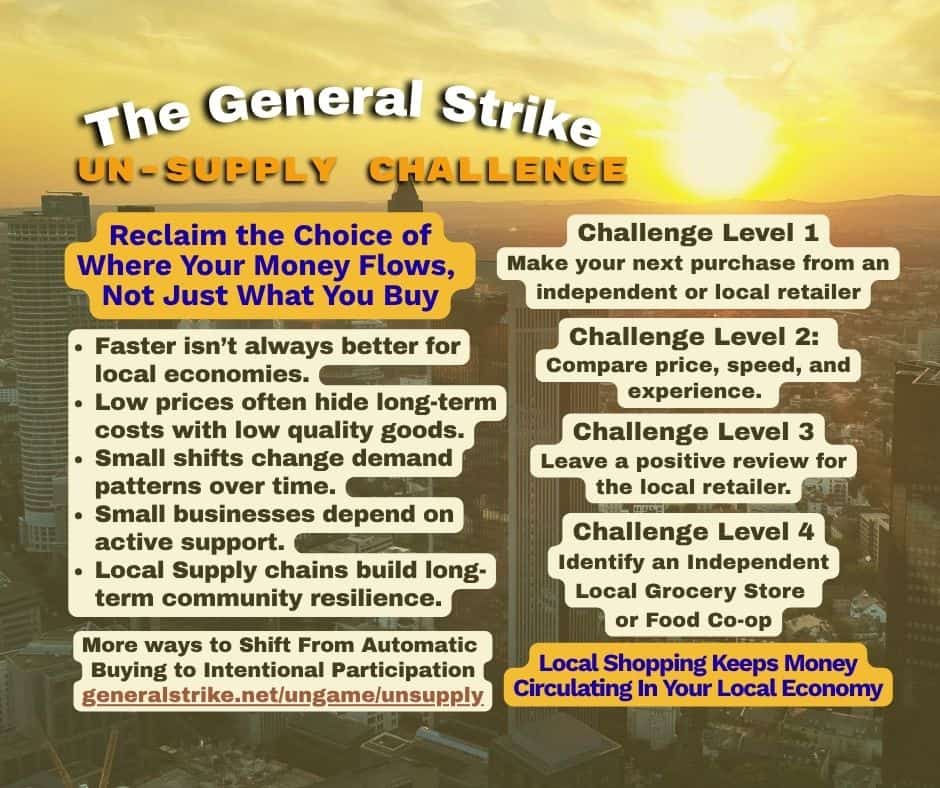
Make your next purchase, online or in your town, from an independent retailer instead of the online behemoth or a warehouse marketplace.
Choose one item you were already planning to buy.
Spend a few extra minutes finding a local shop, an independent website, or a small-business alternative.
When we do this, our purchasing reflects our intentions rather than default behavior.
If this is how you want to spend, take this step. Repeat it as often as you want. Or not. This game is all about choices.
Simple Directions Explained
Start with something you already need.
Don’t make a new purchase just for this challenge. The goal is not to consume more or less. It is to redirect our existing demand.
Search for independent options.
Use terms like “local shop,” “independent retailer,” or search within your town or region. If online, look for businesses that operate outside major marketplace platforms.
Evaluate the experience.
Notice differences in price, shipping time, communication, or product selection. These observations are part of the awareness process.
Complete the purchase.
Follow through with the alternative option you’ve selected.
If challenges arise, adapt the process to your reality—availability, budget, and timing all matter. You know your circumstances best.
Extended Challenge
Level 2: Compare price, speed, and experience
between the independent retailer and a warehouse marketplace. Notice what differs beyond cost.
Level 3: Leave a positive review for the independent retailer.
Visibility plays a meaningful role in helping small businesses remain competitive.
Level 4: Search for a local food co-op or community-supported agriculture option
Search “food co-op near me.” Explore how cooperative supply systems operate differently from centralized marketplaces.
Each level expands awareness from a single purchase into a broader understanding of supply systems.
Why This Matters
How Americans spend their money shapes and sustains supply systems. When we “Buy Local” we reinforce local supply chains and local economies.
Large warehouse marketplaces operate on centralized distribution, predictive logistics, suppressed wages, and high-volume transaction flow. Their strength comes from consistency. The more we default to them, the more predictable demand becomes.
This cycle reinforces itself.
We are dependent on these systems in part because they have been designed to be the easiest option.
- They are fast because they are optimized.
- They are optimized because they are used.
- They are used because they are easy.
Every purchase contributes data. That data improves prediction. Better prediction increases efficiency. Increased efficiency lowers friction, which encourages us to use the systems more.
That predictability allows these systems to optimize pricing, delivery speed, and inventory at scale. Scale creates pressure that often squeezes everything and everyone for more profit and control.
Independent retailers operate differently.
They rely on visibility, relationships, and intentional participation. Their survival depends less on automation and more on whether people choose them.
When we occasionally redirect our purchases, we introduce variability into a highly optimized system.
When we do this, economic participation remains distributed rather than concentrated.
Over time, even small shifts in purchasing behavior can influence which systems grow and which ones remain viable. Strong local markets and businesses are good for everyone in the community.
Independent retailers exist outside of this optimization loop.
They operate with less predictive power, less logistical scale, and less automated visibility. Their survival depends on active choice rather than passive flow.
This challenge does not attempt to dismantle large systems.
It introduces intentional participation within them.
We are not removing ourselves entirely from existing infrastructure.
We are redistributing where and how we engage.
Sudden withdrawal from centralized systems would create instability, supply gaps, and uncertainty. These systems currently fulfill real needs.
Strategic redirection, however, creates balance.
When participation becomes more intentional and less automatic, systems must adapt to remain relevant. When we do this as a community, we
This is how leverage is introduced without disruption.
A Note of Reflection
What influenced your decision about where to purchase today?
Was it speed, price, familiarity, or something else?
And before starting the Un-Game, would you have considered an alternative at all? As you move through the Awareness Zone, notice how often convenience makes decisions for you.
Awareness creates the possibility of choice.
- If you made one intentional purchase today, you’ve already shifted the pattern.
- If you explored options but returned to your usual platform, that awareness still matters.
Most people move through supply systems without ever examining them. You paused long enough to notice. That is how change begins.
Helpful Tools
LocalHarvest.org
A directory that helps you find local farms, food co-ops, and community-supported agriculture programs in your area.
Search “food co-op near me.”
A simple way to locate cooperative buying options that operate outside centralized retail systems.
Community business directories
Often maintained by local chambers of commerce or civic groups, these directories highlight nearby independent retailers.
CSA (Community Supported Agriculture) listings
Allow you to purchase directly from producers, supporting local supply chains and reducing reliance on large distribution networks.
USDA
Explore community supported agriculture (CSA) programs
SBA
Anchor: support small business resources and insights: